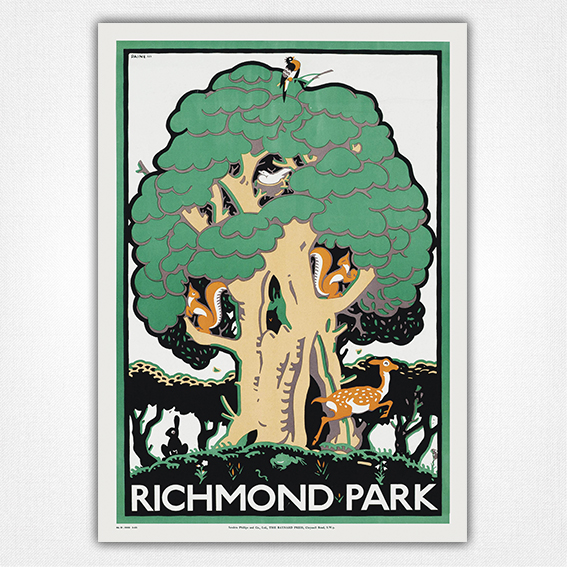
Richmond Park poster Charles Paine 1925 – London Underground Poster – London Transport poster
In this impressive Richmond Park poster the artist Charles Paine has used two of his most common signature motifs to create an image that has significant historical context whilst skillfully capturing nature and the beauty of the park’s natural surroundings. Paine’s beautifully crafted image depicts several of the oak trees that can be found in the London’s countryside park. In fact, according to the Ancient Tree Inventory, London’s largest Royal Park is home to around 1000 trees including birch, ash and sweet chestnut trees which have reached around 80-120 years old which are classified as veteran trees. A further 320 of the park’s woodland is made up of oak trees that are 400 years old and even older, which are classified as “ancient”.
Oak trees holds a special place in the hearts of the British public. It’s the most common species of tree in England. The oak tree depicted in the poster is a stylised version of one of Richmond Park’s most impressive oaks. It is known as “The Royal Oak” and it still stands near Pen Ponds on the grounds of the park as it had for centuries before Charles I enclosed the park in 1637.
The tree is located near the gate entrance, at the top of Richmond Hill, on the path between Sidmouth Wood and the QE Plantation. The Royal Oak is the extravagant arboreal signature of Richmond Park. From its position on Richmond Hill, there is an uninterrupted view of St Paul’s Cathedral, 12 miles away.
The wonderfully gnarled and squat oak tree is recognisable by its split, hollow trunk. The tree is thought to be one of the oldest in England and is estimated to be around 750-800 years old. Paine’s choice of the Royal Oak as the centrepiece for the poster is significant, as it taps into the tree’s historical and cultural significance as a symbol of strength and endurance. Charles Paine was not only highlighting the natural beauty of the park but also its rich history.
A closer inspection of the oak tree and its surroundings in the image reveals other secrets that can be discovered in Richmond Park. Paine has hidden a white dove nesting within the protective cover of the tree’s branches and leaves. A woodpecker sits at the top of the tree branches offering birdsong. The birds symbolise the diverse range of species that inhabit Richmond Park’s vast 2,500-acre expanse. Around 144 different species have been recorded over the past decade. Among these are the Skylark, Wren, Red Kite, Kingfisher and the Ring-necked Parakeet. Others include the Sand Martin, Great Crested Grebe, Reed Bunting, European stonechat, and meadow pipit and all three, the Green, the Greater and the Lesser-spotted Woodpeckers. The park’s common waterfowl population includes Mute Swan, Canada Goose, Greylag Goose, Mallard, Mandarin Duck, Tufted Duck, Common Pochard, Red-crested Pochard, and Northern Shoveler.
In the lower branches of the old oak tree, the artist has depicted two red squirrels who appear to be keeping an eye on each other as they squirrel away their nuts for the winter. In the hole in the trunk between the two squirrels almost hidden from view, you can just make out the silhouette and beak of one of Richmond’s tawny owls and a bat hanging upside down. Below the canopy of the oak trees taking shade from the sunlight, Paine has included the dark shape of a brown hare which is keeping a beady eye on our movements. Brown hares were once common in the park but have since vanished as a consequence of increased disturbance in the park. However, the park’s 955 hectares are home to plenty of rabbits.
To the right of the oak tree, a startled young fallow sprightly springs out of the hollow in the tree trunk to make a run to join the safety of the herd of k 630 Red and Fallow deer that have roamed freely in the park since 1637. As have the grass snakes, common lizards, common frogs nd common toads some of which are represented on the grass-covered mound at the foot of the tree along with some of the area’s flora including snowdrops. Other than the name of the destination “Richmond Park” there is no other wording on the poster. There is however, one more tiny creature to be found!
The poster was part of a continuing campaign to increase passenger traffic on the Underground network by persuading Londoners to use their leisure time for day trips and weekend jaunts to historic houses, museums, suburban beauty spots and parks. In this particular case, it was to encourage city dwellers to get out of the hectic city and enjoy the calming delights of London’s Richmond Park.
The Royal Oak serves as a symbol of the enduring qualities of strength and resilience. The oak is known for its sturdy trunk and deep roots, which allow it to weather even the strongest storms. In the context of the poster, the oak tree thus becomes a metaphor for the stability and reliability of the underground railway system, suggesting that it is a safe and dependable way to explore the city and its attractions.
Richmond Park
Richmond Park is a majestic park located in southwest London that has a rich history dating back to the medieval era. The park’s royal connections can be traced back to Edward I (1272-1307), who was the first monarch to reside in the area, which was then known as the Manor of Sheen. During Henry VII’s reign, the name was changed to Richmond, which means “stronghold” or “fortress”. Over the years, the park has been home to several royal residences, including Richmond Palace, which was built by Henry VII in 1501. The palace served as a royal residence for over 200 years and was the location of several significant historical events, including the birth of Elizabeth I in 1533.
In 1625, Charles I brought his court to Richmond Palace to escape the plague in London, and he subsequently turned the area into a park for hunting red and fallow deer. In 1637, Charles I decided to enclose the land, which was met with resistance from the local residents. Nevertheless, he granted people right of way, and to this day, the park’s walls remain, although they have been partially rebuilt and reinforced.
Over the years, the park has undergone several transformations, including the introduction of formal gardens, sporting facilities, and recreational spaces. During the 18th and 19th centuries, the park was a popular destination for outdoor activities such as horse racing, cricket, and archery. In the early 20th century, the park was used for military purposes during World War I, and it served as a landing ground for airships during World War II.
Today, Richmond Park is a protected conservation area and is home to several rare and endangered species of flora and fauna. The park’s natural beauty and historical significance make it a popular destination for visitors from all over the world. Visitors can enjoy activities such as hiking, cycling, picnicking, and wildlife watching, as well as explore the park’s historical sites such as Pembroke Lodge, King Henry’s Mound, and the Isabella Plantation.
Richmond Park has changed little over the centuries and although it is surrounded by human habitation, the varied landscape of hills, woodland gardens and grasslands set among ancient trees abound in wildlife. The park spans an area that boasts stunning natural landscapes, historical sites, and recreational facilities that today make it a popular attraction for both locals and tourists alike. Today the park is a national nature reserve and a Site of Special Scientific Interest. It is visited by more than 5.5 million people each year.
Other Charles Paine posters
Charles Paine’s career accomplishments are extensive. His work encompasses stained glass, book illustration, watercolour and acrylic painting. It includes interior design, commercial advertising, teaching, as well as textile and wallpaper design. Today he is probably best known for his many poster designs for companies, including London Underground, Empire Marketing Board, and the GPO, and his work for Penguin Books, and Sundour Fabrics.
The Pendleton-born artist was clearly a gifted talent in the art and crafts tradition. Starting out at the Salford School of Art in Manchester, Paine was apprenticed to the craft of making stained glass. Paine honed his craft at the Royal College of Art before leaving London to work for the Applied Art Department of Edinburgh College of Art under John Platt, who had a significant influence on Paine’s work. It’s believed that Platt introduced him to Frank Pick, who commissioned Paine to design many posters for the London Underground.
Whilst Charles Paine produced posters for a range of companies it is his iconic work for various London transport organisations that he is best remembered for. His breathtaking designs adorned underground, bus and tram stations for nearly a decade. From 1920 to 1929, Paine created more than 20 stunning posters that captured the essence of the city and its culture. Among his most cherished designs are those that continue to captivate audiences with their timeless beauty and charm including his fabulous 1922 Kingston By Tram poster that features the four white Kingston Swans zig-zagging down the River Thames. It was the first poster the artist created for the London Transport company. One of his most eye-catching designs is the 1921 Uxbridge poster that depicts 13 golden and one red fish swimming in blue and teal waters.
In 2013, Paine’s Uxbridge (fishes) poster design was one of three Paine posters featured in the 150 best posters exhibited by London Underground during the 150th-anniversary celebrations. The other two were probably his two most popular and recognised designs, which, even if you didn’t know the artist by name, have become iconic images of the golden age of the underground and are familiar to most people. The first is his 1921 For the Zoo poster which depicts a waddle of blue, black and white penguins set against a yellow background. It is one of the underground’s most iconic posters and is highly sought after with one original copy selling for almost £10,000 back in 2013. The other Underground poster to feature in the 150th-anniversary celebrations was the 1925 Richmond Park poster that combines natural elements with history in the shape of the park’s wildlife and the famous 750-year-old oak tree, known as the Royal Oak.
Another poster by the Mancunian-born artist we’d like to include is his Barnet by Tram poster created in 1922. The design published by the Underground Electric Railways Company of London features an superb image of seven ponies corralled at the Barnet horse fair… an annual horse and pleasure fair that used to be held near Mays Lane, Barnet, England.
One poster Paine created for the London Underground was used to advertise an important sporting event rather than a specific tube destination. It was the poster advertising the 1923 Boat Race between Oxford and Cambridge. The spectacular poster appeared in the tube train carriages across London in February and March 1923. Paine’s simple graphic shapes, dynamic compositions and use of bold, flat colours were a perfect solution for poster design.
Paine’s style was innovative, departing from the standard advertising of the time, which often featured literal representations of the subject. Instead, he used simplified forms and large blocks of colour, making his posters interesting, eye-catching and effective. His limited use of colour also made the posters economical to reproduce, and by the mid-1920s, other poster artists widely copied his approach.