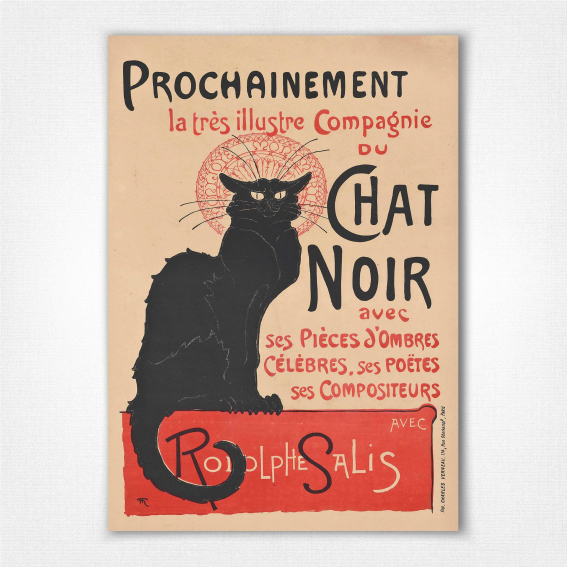
Le Chat Noir poster – Prochainment la trés Compagnie du Chat Noir poster
The famous French Le Chat Noir poster has become one of the most iconic affiche designs of the “fin-de-siècle” era. It was created by the Swiss born artist Theophile Alexandre Steinlen to promote the nineteenth-century entertainment establishment known as Le Chat Noir, French for The Black Cat.
Le Chat Noir was a French nightclub that is perhaps best now known for its iconic Théophile Steinlen designed Le Chat Noir poster. The establishment was created, hosted, and owned by Rodolphe Salis. It first opened its doors on 18 November 1881 at 84 Boulevard de Rochechouart. The venue was located in the bohemian Montmartre district of Paris. In just three and a half years Le Chat Noir outgrew the venue and moved to larger premises at 12 Rue Victor-Masse.
Le Chat Noir was the first modern cabaret nightclub
With much larger premises it wasn’t long before the iconic Chat Noir became one of the most famous new artistic cabarets in Paris during late 19th century. It became a gathering place for a growing crowd of upcoming, modern poets, writers and singers. In its heyday, it was an extremely popular bustling nightclub that was part artist salon, part rowdy music hall. Le Chat Noir is now widely considered to be the first modern cabaret.
Le Chat Noir was the first avant-garde literary, artistic and musical cabaret in Paris. A sign on the building’s entrance encouraged it’s patrons to ‘Be Modern above all else”. The nightclub was a place of innovation and improvisation. A place where each night was different from the previous one. The evenings were filled with poetry performances, sentimental and satirical songs, stories and improvised monologues, irony and humor!
Pianists and composers such as Paul Delmet, Albert Trinchant, Erik Satie, Claude Debussy and Gustave Charpentier played and or composed their music at the Chat Noir. Singers, poets and dancers including Jane Avril, Yves Guilbert, Theodore Botrel and Aristide Bruant would perform there. Poets, playwrights and writers Emile Gordeau, Charles Cross, Frank-Nohain, Paul Verlaine, Jules Laforgue and Paul Bilhaud and not only did artists such as Adolphe Willette, Henry Toulouse Lautrec and, of course, Theodore Alexandre Steinlen regularly frequented the Montmartre nightclub and their artworks adorned the walls of the venue.
Le Chat Noir shadow theatre
In 1885, a shadow theatre was added to the third floor of the new Chat Noir. An ornate, darkened room filled with curiosities from around the world and contemporary art created by Edgar Degas, Claude Monet and Henri de Toulouse-Lautrec hung on the walls.
It was here that artist Henri Riviére and his collaborators resurrected the art of ‘shadow theatre’. An article on the Barbican.com website describes how shadow theatres worked: “The productions were animated by silhouettes of zinc figures, sometimes with the addition of more detailed props and landscape elements. Light from an open flame was projected from backstage onto the figures, interlaid with hand-painted glass sheets, conjuring complex atmospheric effects. The plays ranged from solemn epics to fairy tales and satires. As the techniques improved the performances became more and more elaborate. They were a big hit with the French public.
Such was the success of the shadow theatre that the plays became the main attraction of the Chat Noir cabaret. So much so that in 1896, Rodolph Salis organised a company of performers from the cabaret to undertake a tour of cities throughout France.
Le Chat Noir poster
Rodolphe Salis asked Steinlen to design a poster to announce the tour. Steinlen came up with the now infamous Chat Noir poster.
The poster depicts a black cat sitting on a red ledge against a bold yellow background. The art nouveau-styled feline is staring hypnotically towards the viewer. The cat’s rough jagged contours of Steinlen’s cat mimic those of the shadow theatre’s cut-out figures.
The cat’s head is framed by an ornate halo design. The halo is reminiscent of the religious halos painted around the saints in medieval and renaissance paintings. Maybe it was an homage, a nod, to Alfonse Mucha who used similar motifs in some of his works. Maybe it was intended to present the cat as a saint. Making the Black Cat venue a place to be worshipped by all.
In the crown’s delicately detailed framework, are two words. They read: “Montjoye Montmartre.” Montjoie is the battle cry of the French soldiers during the middle ages. The message can only be seen as a statement of pride and allegiance to the bohemian area of Montmartre the venue was based in.
What does the Chat Noir poster say?
In this version of the poster is the exclamation ‘Prochainment la trés Compagnie du Chat Noir aved ses pièces d’ombres célébres, ses poëtes, ses compositeurs de Rodolphe Salis. This translates into English as ” Coming Soon, the very illustrious company of the Black Cat with its famous shadow plays, its poets and its composers. Presented by Rodolphe Salis. Steinlen’s cat poster would have served as a “coming attractions” announcement to be posted in the town’s and outside the venues of the hosting cities and venues.
What is Le Chat Noir?
Le Chat Noir is French for The Black Cat. It was a bustling French nightclub in the bohemian Montmartre district of Paris. The venue was opened on 18 November 1881 at 84 Boulevard de Rochechouart by the impresario Rodolphe Salis. Part artist salon and part rowdy music hall, the venue quickly became popular with the most famous writers and artists in Paris. Le Chat Noir is now widely considered to be the first modern cabaret. A nightclub where the patrons sat at tables and drank alcoholic beverages while being entertained by a variety show on stage. Le Chat Noir is perhaps best known for its iconic Théophile Steinlen designed Prochainment Tournée du Chat Noir poster.
Théophile Alexandre Steinlen
Steinlen, was a Swiss-born French Art Nouveau painter and printmaker during La Belle Epoque era, a golden period in French history. The artist played an important role in the development of Art Nouveau. He is best known for his posters and illustrations, which often featured bold, decorative patterns. His work was heavily influenced by Japanese woodblock prints, and he is credited as one of the artists that helped to popularise this style in the West. Steinlen also had a strong interest in cats, and his poster for the Chat Noir cabaret is one of his most famous images.
Who was Rodolphe Salis?
Rodolphe Salis was the creator, host, owner and Master of Ceremonies of Le Chat Noir. The venue is probably better known for its Theophile Steinlen designed Tournée du Chat Noir poster than its position as the first modern cabaret club. Salis established a club where the patrons could sit at tables with alcoholic drinks and enjoy an almost unlimited variety of acts.
It opened in 1881 with artists as diverse as Jane Avril, Franc-Nohain, Adolphe Willette, Caran d’Ache, André Gill, Émile Cohl, Paul Bilhaud, Sarah England, Paul Verlaine, Henri Rivière, Claude Debussy, Erik Satie, Charles Cros, Jules Laforgue, Yvette Guilbert, Charles Moréas, Albert Samain, Louis Le Cardonnel, Coquelin Cadet, Emile Goudeau, Alphonse Allais, Maurice Rollinat, Maurice Donnay, Armand Masson, Aristide Bruant, Théodore Botrel, Paul Signac, Porfirio Pires, August Strindberg, George Auriol, Marie Krysinska, and Henri de Toulouse-Lautrec frequented or performed at the popular venue.
The demise of Le Chat Noir came about just a year later with the death of Rodophe Salis on 19 March 1897. By that time the fascination with Montmartre had already diminished, and Salis had already disposed of many of the club’s assets and facilities. Soon after Salis’ death, the artists dispersed, and Le Chat Noir disappeared from the scene.
Our posters are carefully and professionally created from vintage originals. Whilst great care is taken in the production of these posters, we also try to maintain a vintage feel, so there may be small imperfections, fold marks, scuffs, tears or marks that were part of the original poster master. If these do appear they should be visible on the larger views of the item on this listing. The originals of many of the posters we offer can cost many thousands of pounds, so whilst these posters look great, especially framed and mounted on a wall, they are intended as a fun, affordable reproductions and not intended fine art prints.
The 50x70cm version has been specially produced to be used in conjunction with Ikea’s 50x70cm Ribba picture frame which currently retails for around £15.