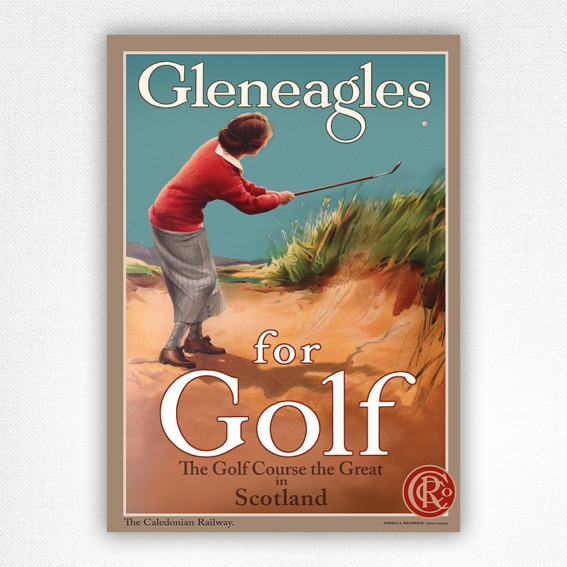
Gleneagles for Golf poster – The Caledonian Railway poster – c1920
This is a reproduction of a fabulous vintage Gleaneagles for Golf poster. that was originally published by the Caledonian Railway between 1920 and 1923. The poster, created by an unknown artist, features one of Caledonian Railway’s “Golfing Girls”.
The Golfing Girls of the Caledonian Railway.
In the early 1920s, the Caledonian Railway company embarked on a poster advertising campaign to entice rail passengers to use their railway lines. Inspired by, or possibly inspiring, the posters bear a similarity in both concept and imagery to the successful and popular Kodak Girl posters created for the famous camera and film manufacturer. The Caledonian Railway commissioned a series of advertising posters that featured “The Golfing Girl”. Each poster featured an elegantly dressed woman taking part in a different aspect of the noble game. One titled A True Line Drive features a young woman teeing off. Another called Her Winning Way depicts a victorious-looking golfing girl successfully putting on a green. Another Gleneagles poster featuring The Golfing Girl is titled “A braw “brassie” on the True Line. It features a young woman on the fairway taking her stroke with a 2-iron.
The vintage golfing poster-come-railway poster on this listing is titled “Gleneagles for Golf”. It was originally produced, by an unknown artist, some time between 1919 when the Gleneagles golf course opened and 1923 when the Caledonian Railway Company became part of the London, Midland and Scottish Railway (LMS). The Caledonian Railway poster doesn’t mention its popular hotel because it was still in construction at the time.
Caledonian’s ‘The Golfing Girl’ prints predominantly presented female golfers above theiur male counterparts. The Gleneagles for Golf poster features a lady golfer caught in a sand trap. With a sand wedge in her hand the young woman has to play one of the most difficult shots in golf. Standing in the sand hazard the woman swings her golf club at the ball lying under the lip of the steep-sided hole. It’s a great shot as the ball soars in the sky and heads towards the green.
The vintage railway print reads “Gleneagles for Golf – The Golf Course the Great in Scotland – The Caledonian Railway”. The red and white Caledonian Railway logo appears in the bottom right-hand corner of the image.
The Gleneagles Hotel and its famous golf courses
The original vision for Gleneagles was formed in 1910. It was dreamed up by Donald Matheson, the then General Manager of the Caledonian Railway Company,whilst on holiday in Strathearn. Matheson, according to the Gleneagles website, was so impressed by the local countryside that he conjured up the vision of a palatial country house hotel with a golf course. Gleneagles Ltd was formed in 1913 to construct and operate the proposed hotel and golf course. Plans were also put in place to replace Crieff Railway Station with a new station. The new station serving the town of Auchterarder in Perth and Kinross was renamed Gleneagles.
Construction on the magnificent three-storey Georgian building began in 1913. However, the project was halted with the outbreak of the First World War in 1914. Construction on the hotel wasn’t resumed until 1922.
Matheson engaged the services of the Scottish professional golfer and five times winner of the Open Championship. Braid was commissioned to design and create two golf courses in the rugged terrain of the hotel grounds. The now famous King’s and Queen’s courses were opened on 1 May 1919, five years before the hotel.
“Gleneagles for Golf – The Caledonian Railway Scotland”
In the early 1920s, the Caledonian Railway company embarked on a poster advertising campaign to entice rail passengers to use their railway lines. Inspired by, or possibly inspiring, the posters bear a similarity in both concept and imagery to the successful and extremely popular Kodak Girl posters created for the famous camera and film manufacturer. The Caledonian Railway commissioned a series of advertising posters that featured “The Golfing Girl”. Each poster featured an elegantly dressed woman taking part in a different aspect of the noble game. One titled A True Line Drive features a young woman teeing off. Another called Her Winning Way depicts a victorious-looking golfing girl successfully putting on a green. The vintage golfing poster-come-railway poster on this listing is titled A braw “brassie” on the True Line.
Despite the way it sounds, the ‘braw brassie’ reference doesn’t relate to the young female golfer. Depending on how it is used the word braw in Scottish can mean lovely, appealing, eye-catching and even beguiling – as in the lyrics to the famous Scottish song It’s a braw bricht moonlit nicht the nicht meaning It’s a lovely, bright moonlit night tonight. In this Golfing poster, the word is coupled with ‘brassie’ To the uninitiated, a ‘Brassie’ has nothing to do with the lassie or girl playing the shot. A brassie was the name of an old wooden golf club that closely resembles the modern 2-wood or 3-wood club. Its name derives from the brass base plate on the head of the club.
The Golfing Girl poster was illustrated by an unknown artist and features an image of a rosy-cheeked golfer wearing a tartan skirt and jacket. The young woman has been captured having just played her shot and judging by the enigmatic smile, it was good. The golfer’s successful swing is set against the beautiful, picturesque bens and glens of the impressive Scottish countryside.
The red and white Caledonian Railway logo appears in the bottom right-hand corner of the image. Beneath the image, the poster reads “The golfing girl and her golfing friends acquire their healthy glow and happy buoyancy on the sporting and picturesque golf courses served by The Caledonian Railway. The vintage Caledonian Railway poster then goes on to provide a list of 24 Scottish towns with golf clubs that can easily be reached by The Caledonian Railway. Destinations include Aberdeen, Crawford, Crieff, Dunblane, Dunoon, Gleneagles, Lanark, Moffat, Oban, Peebles, Rothesay, Saltcoats, Stonehaven and Wemyss Bay.
There’s a long history of women in golf.
According to an article by Joseph Beditz in Jan 2022 on the National Golf Foundation website reckons that women now account for 25% of golfers. Given that an estimated 66.6 million people play golf throughout the world, the figure suggests there are 16.6 million female golfers enjoying the sport and the number is increasing. The statistics are surprising but they shouldn’t be. Players such as Lydia Ko, Brooke Henderson, Atthaya Thitikul, Minjee Lee, Jennifer Kupcho, Leona Maguire and Nelly Korda have certainly had an influence and inspired women to play golf. However, women playing golf goes back to at least 1552, when it was played by no less a person than Mary, Queen of Scots. She is said to have played the game regularly having learned it during her childhood in France. In fact, it is understood that she is responsible for coining the term “caddy” by calling her golfing assistants cadets.
The origins of golf are said to date back to the reign of Julius Caesar when a feather-stuffed ball was hit with club-shaped tree branches. A similar game came also be traced back to the Song Dynasty in China, sometime between 960 to 1379. However, it is widely accepted that the roots of the game as we know it, where the ball was to end up in a hole in the ground, began in Scotland around 1400. We know this because the first documented record of golf in Scotland dates back to 1457 when King James II of Scotland banned both golf and football because the sports were so popular, the King was concerned his subjects weren’t practising their archery enough during Scotland’s ongoing wars with England!
The first documented reference to women playing golf appeared in the Edinburgh newspaper, the Caledonian Mercury as well as in newspapers in London, Carolina and Pennsylvania. The articles reported that two married women had played a match on Bruntsfield Links in Edinburgh on 24th April 1738… with their husbands acting as caddies! The story caused quite a stir as it reported that the match attracted quite a crowd and gambling. The article complimented the women on their ‘dexterity’ in “holing out” as well as how manfully they ’tilted’ the balls. The event was won by ‘Charming Sally’, although her surname and the name of the rival are still unknown.
The first recorded women’s golf tournament dates back to the reign of King George III. It was held on January 9th, 1811 in the Scottish village of Musselburgh in East Lothian. The tournament was held between local fisherman’s wives of Musselburgh and neighbouring Fisherrow on an eighteen-hole pitch and putt golf course at the Musselburgh Golf Club. The winner received a creel and a shawl with the runner-up being awarded two handkerchiefs. According to the Guinness World Records, Musselburgh is the oldest surviving course in the world. It was the venue for the Open Championship six times between 1874 and 1889. The course is still in use today.
St. Andrews is widely considered the “home of golf”. It is certainly home to the Royal and Ancient Golf Club which was established in 1754. It was golf’s leading authority, administering the rules of the game and running the Open Championship. St Andrew’s opened the world’s first 18-hole course. When the world-famous “Old Course,” was constructed it became the standard for golf courses across the world. Just as significant is the fact that in 1867 St Andrew’s became the home of St Andrews Ladies’ Golf Club, the oldest ladies’ golf club in the world.
From then Women’s golf started to take off. 1893 saw the formation of the Ladies Golf Union. A series of ladies’ golf tournaments soon took place across the globe. Some of the earliest women’s golf events include New Jersey and Australia in 1894, and New York in 1895. As the new century began a women’s tournament was played at the 1900 Summer Olympics. It was the only time women’s golf was featured at the Olympics until 2016!
Since the 1900s women’s golf has come on in leaps and bounds. Players such as Dorothy Campbell, Betty Jameson, Glenna Collet Vare, Joyce Wethered, Louise Suggs, Babe Zaharias, Kathy Whitworth, Nancy Lopez, Betsy King, Patty Sheehan, Betsy Rawls, Patty Berg, Mickey Wright and Annika Sorenstam have all contributed massively to the rise in women’s golf either as sport to partake in but also as a spectator sport. In fact, record crowds of more than 90,000 spectators attended The 2019 Solheim Cup – the highest attended women’s golf event in British history.
The Caledonian Railway
The Caledonian Railway was a major Scottish railway company between 1847 and 1923. It was formed with the objective of connecting to the English railway network and providing a railway line between London and Glasgow. With the opening of the Caledonian Mail Line from Carlisle to Beatock in 1847 and between Glasgow and Carlisle in Feb 1848, a continuous railway route between Glasgow and London was established for the first time.
The company progressively extended its network and soon reached Edinburgh and Aberdeen and creating a dense network of branch lines in the area around Glasgow. The company also developed a considerable passenger service to the Firth of Clyde, serving many of the island towns and resorts. Fast boat trains were run from Glasgow to steamer piers and although the Caledonian Railway was refused permission to operate its own steamers, it formed a partnership with the Caledonian Steam Packet Company. The Caledonian Railway quickly established itself as the dominant route from Central Scotland to England, rivalling the Glasgow and South Western Railway and the North British Railway.
The Railways Act of 1921 forced many individual railway companies in Britain to merge and the Caledonian Railway was no exception. The company was grouped with the Glasgow & South Western Railway, the Highland Railway, the London & North Western Railway, the Midland Railway and a number of smaller railways across Scotland and England to form the London, Midland & Scottish Railway Company. The LMS inherited 3,040 Coaching, 51,536 Freight and 1,786 Service vehicles and 1,114 route miles from the Caledonian Railway. Many of the carriage designs such as the Grampians had been at the leading edge for style and comfort at the time of their introduction. The Caledonian was also one of the first UK companies to introduce Pullman coaches. The Company also owned two very fine hotels as part of the stations at Glasgow Central and Edinburgh Princes Street. The development of the majestic hotel and golf course at Gleneagles was interrupted by WWI and was not fully completed until after the grouping. The legacy of Caledonian Railways is still evident today and many of its principal routes are still used. Although the term Caledonian main line has no official present-day meaning, the line is in use as part of the West Coast Main Line railway and is still generally taken to mean the main line between Carlisle and Glasgow and Carstairs and Edinburgh.
How much is a Caledonian Railway Gleneagles for Golf poster worth?
Like many of the vintage posters, prints and wall art on our website this Caledonian Railway poster is considerably rare and highly sought after. It would seem that not too many of the originals have survived the 110 years since they were first published. The posters rarely come up for sale through online stores or auction sites. It is a vintage poster that appeals to a new generation of female golfers. It also appeals to collectors of golfing memorabilia, railway poster collectors, Scottish poster aficionados and general poster collectors alike. Its appeal across a variety of genres helps push up the value of the original prints. In 2018, an original copy of this Golfing Girl poster went to auction and achieved a sale price of £3,500.
There’s no argument from us, if you can find an original copy and can afford to buy it, you’re on to a winner. There’s nothing like owning an original vintage poster and they often make a great investment. Chances are in just a few years you’ll be able to sell it for more than you paid for it. Unfortunately, for most of us, an investment, even at the entry-level prices of the collectable poster isn’t even close to being a possibility. This is where our stunning high-quality reproductions come into their own.
This vintage poster is certainly not par for the course, in fact,, we think it’s ace. Not only does it cost a fraction of an original it’ll look absolutely ‘braw’ when it’s framed and hung on your living room wall. Order your copy today.