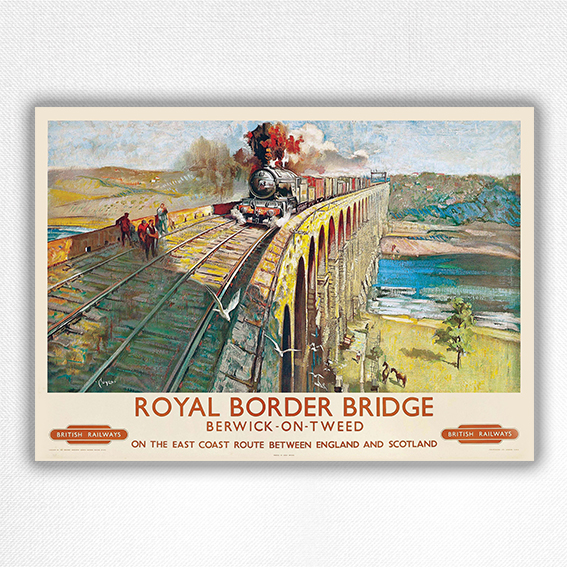
Royal Border Bridge poster Berwick-on-Tweed Railway poster – Cuneo
A Captivating Glimpse of the Golden Age of Steam
The vintage Royal Border Bridge poster, created for British Railways, perfectly captures an undeniable nostalgia surrounding steam trains. Revered by railway enthusiasts, cherished by seasonal holidaymakers, and beloved by generations of travelling tourists, these locomotives hold a timeless allure.
Terence Cuneo’s stunning artwork for this Royal Border Bridge poster is a masterpiece of its kind, transporting viewers to a moment in time when rail travel was at its most elegant.
The hissing steam that envelopes the locomotive as it waits patiently, the plumes of dancing smoke billowing from the chimneys, and the rhythmic rumble of the train running at high speed all combine to evoke a bygone era. Cuneo, a prolific English painter, is renowned for his scenes of horses, military, and automobiles.
However, it is his poster designs featuring his beloved steam trains, like the iconic Royal Border Bridge poster, that he is probably best known for.
The Masterful Artistry of Cuneo’s Design
Cuneo’s Berwick-on-Tweed Royal Border Bridge poster is a perfect example of his genius. It features one of Sir Nigel Gresley’s LNER Class V2 2-6-2 locomotives, the famous Green Arrow freight train, steaming its way across the iconic Royal Border Bridge.
The artist’s vantage point places us trackside as the locomotive thunders across the river, hauling its heavy load unencumbered. A team of four ‘Permanent Way’ workers have stepped to the side of the stone bridge, taking a well-deserved break to allow the speeding train to pass.
The high viewpoint from the top of the Grade I listed railway viaduct offers us stunning views of the River Tweed as it winds its way through the beautiful English countryside bordering Scotland. At more than 120 feet above the Tweed, we feel as though we are soaring with the seagulls in the painting, truly capturing the essence of the Royal Border Bridge poster.
The remarkable detail is so realistic that you could be forgiven for feeling a little unsteady as you glance down to the ground level, where a young woman tends to two horses in the field below. The text is kept to a minimum, allowing the stunning image to entice rail passengers.
The Royal Border Bridge: A Victorian Marvel
Stretching gracefully over the meandering waters of the River Tweed, the Royal Border Bridge unites the towns of Berwick-upon-Tweed and Tweedmouth in Northumberland, England. Built between 1847 and 1850, this iconic railway viaduct is a Grade I listed monument and a prime example of Victorian architectural finesse.
The project was designed and overseen by Robert Stephenson, the son of railway pioneer George Stephenson, and was opened by Queen Victoria herself.
The bridge’s significance continues to this day, serving as an integral artery of the East Coast Main Line. Although its name suggests it spans the border between England and Scotland, it lies entirely within the English county of Northumberland.
The bridge extends a substantial 659 meters, arranged in a gentle, graceful curve with 28 elegant arches, each spanning an impressive 60 feet. At its peak, the construction employed 2,700 men and used eight million cubic feet of stone. The magnificent structure elevates the railway 37 meters above the river, offering mesmerising views and an emblematic connection between two worlds.
The Legendary East Coast Main Line
When the Royal Border Bridge was completed in 1850, it formed the final, uninterrupted link of the East Coast Line, connecting London to Edinburgh. Prior to its construction, the journey required a disjointed mix of trains and other transport. The bridge’s completion streamlined this route, creating a continuous railway link between the two capital cities.
In the 1940s, the East Coast Main Line (ECML) was a vital artery, spanning 400 miles and serving as a lifeline for both passengers and freight. The journey from London King’s Cross followed a captivating route through urban towns, countryside, and coastal stretches.
The line was synonymous with luxury travel, hosting prestigious trains like the “Flying Scotsman” and the world-record-setting “Mallard.” These powerful steam locomotives dominated the tracks, providing passengers with an elegant and comfortable way to travel.
Beyond passenger transport, the ECML played a pivotal role during World War II, moving troops, supplies, and equipment. After the war, it supported post-war reconstruction and economic recovery, facilitating the movement of essential goods like coal and steel.
The line’s enduring legacy is a testament to its economic and historical significance, a legacy so beautifully captured in the classic Royal Border Bridge poster.