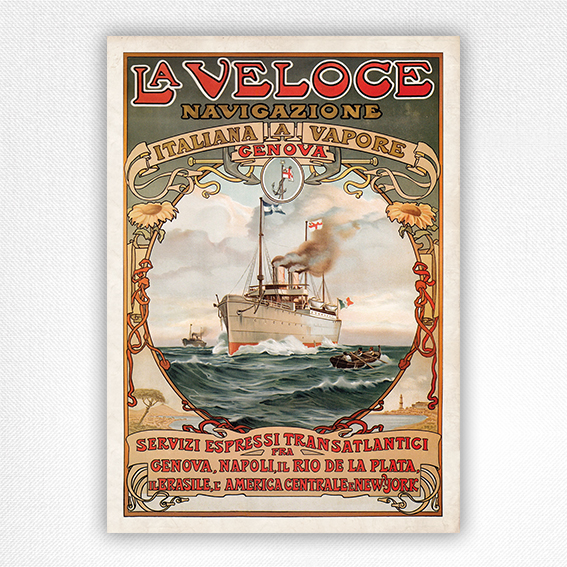
La Veloce poster – A Vintage Voyage from Genoa to New York (1889)
Step back in time and set sail across the ocean waves with this captivating La Veloce poster. A vibrant piece of work influenced by the Art Nouveau movement. The La Veloce poster is not only a stunning visual creation, but also a historical treasure, transporting us to an era of maritime elegance and the thrilling spirit of exploration.
Bathed in the warm hues of a bygone era, the 1889 La Veloce poster proudly proclaims the company’s transatlantic services, beckoning travellers with the promise of adventure. The majestic ocean liner, the Nord America, dominates the scene, her sleek lines and towering smokestacks exuding a sense of unwavering power and grace.
The La Veloce poster features many popular aspects of the art nouveau movement including banners, vines and winding flowers. The text is handwritten in elegant curved lettering, some in wavy lines that evoke the waves of the sea. It reads La Veloce Navagazione. Italiana a Vapore. Genova. Servizi Espressi Transatlantici fra Genova, Napoli, Rio de la Plata, il Brasile l’America Centrale e New York. This translates into English as Fast Navigation. Italian Steam. Genoa. Transatlantic Express Services between Genoa, Naples, Rio de la Plata, Brazil, Central America and New York.
At the center is a magnificent painting of the steamship Nord America crossing the choppy waters of the Atlantic Ocean passing a small rowing boat with three men. The poster is complemented by cameo images of a harbour.
From British Tea Clipper to Italian Explorer: The S.S. Nord America’s Storied Life
In 1882 clanging rivets and billowing steam filled the air as the newly christened S.S. Stirling Castle, built by J.Elder & Co. in Glasgow, slipped into the River Clyde on January 21st, 1882. Destined for tea trade between Britain and China, this sleek beauty quickly earned a reputation for speed and reliability.
Three years later, an enterprising Italian shipping company, La Veloce, saw potential in the Stirling Castle’s prowess. They purchased the vessel, refitted her for passenger comfort, and rechristened her the S.S. Nord America. Yet, such was her renown that the Stirling Castle moniker remained whispered by the waves alongside her new Italian name.
In 1883, the Nord America embarked on a fascinating journey across continents and conflicts. She traversed the Atlantic, serving as a vital link between Genoa and South America. In 1885, she donned the mantle of a troop carrier, ferrying British soldiers to Sudan during the Mahdist War. A decade later, she crossed paths with history again, transporting Russian troops to quell the Boxer Rebellion in China.
The turn of the century saw Nord America grace the transatlantic route, shuttling passengers in opulent comfort between Palermo, Naples, and New York. For seven years, she made 58 round voyages, her decks echoing with the laughter of travelers and the rhythmic pulse of the ocean.
Fate intervened in 1908 when a devastating earthquake rocked Messina, Italy. The Nord America, her engines still warm from transatlantic crossings, transformed into a haven for survivors, offering solace amidst the tragedy. However, her passenger days were numbered. Relegated to cargo duties, she sailed the seas laden with goods until in 1910, disaster struck again.
While carrying horses across the Atlantic, the Nord America met her final challenge, running aground on the Moroccan coast. Though rescued and returned to Genoa, her days were numbered. In 1911, the once proud ship was broken for scrap, leaving behind a legacy of speed, adaptability, and resilience.
La Veloce Navigazione Italiana a Vapore
La Veloce Navigazione Italiana a Vapore was a shipping company with a rich history, sailing the seas from 1884 to 1924. The companies’ roots can be traced back to 1865 when Giovanni Lavarello established a line of small wooden steamers operating between Italian ports. In 1883, M. Bruzzi & Co. took over the Lavarello line and officially formed La Veloce Navigazione Italiana a Vapore, focusing on routes between Italy and South America. The company quickly gained popularity, known for its speed and reliability.
By 1889, La Veloce’s reach extended beyond South America, establishing services to North America and the Mediterranean. German banks saw the company’s potential and began acquiring shares, eventually gaining a controlling interest by 1899. This period also saw La Veloce acquiring the Fratelli Lavarello fleet, further solidifying its position in the shipping industry.
La Veloce boasted a fleet of impressive vessels throughout its history. The star of this La Veloce poster is named Ethiopia. The steamer was launched in 1886, and was one of the first Italian-built ships specifically designed for long-distance voyages.
In 1924, La Veloce was acquired by Navigazione Generale Italiana (NGI), marking the end of its independent operation. However, La Veloce’s legacy lived on within NGI, contributing to the growth and success of the Italian maritime industry.
La Veloce’s journey is a testament to the ingenuity and entrepreneurial spirit of the Italian people. The company’s commitment to speed, reliability, and innovation left a lasting mark on the world of shipping. While La Veloce may no longer sail the seas, its story continues to inspire and resonate with anyone captivated by the romance and history of maritime travel.