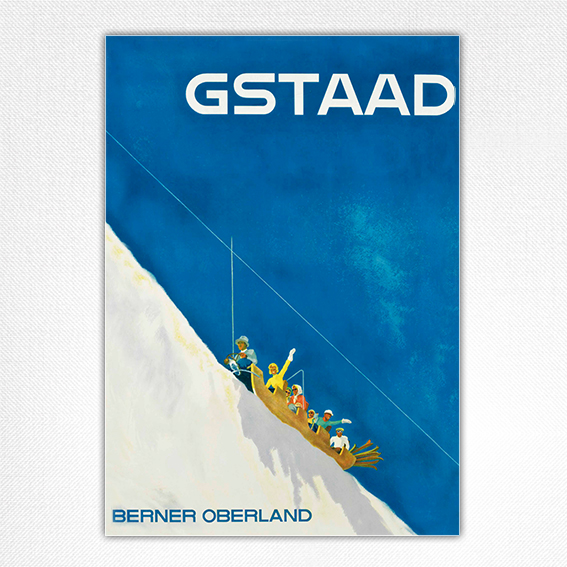
Nestled in the Swiss Alps, the village of Gstaad has long been a popular destination for winter sports. This 1930s Gstaad travel poster promoting the resort shows the famous sleigh lift that transported winter sports guests from the nearby town of Saanenmöser up to the top of the steep Wispile mountain in the Bernese Oberland.
Gstaad poster Berner Oberland
The image on this rare but popular Gstaad poster is truly impressive. The bold, colourful poster sets the white snow-covered mountainside against a deep blue sky. The 45-degree angle replicates the steepness of the Wispile mountain at its steepest and fastest!
The print features a group of happy skiers waving at other skiers in the Alpine resort. The woman dressed in yellow at the front of the sleigh is a particular favorite. She is wearing a huge, beaming smile and is looking directly at us, the viewer, as she is pulled towards the mountain peak in a “funi”.
Before the 1930s it wasn’t as easy to access the slopes as it is today. People had to hike up the mountainside with their skis strapped to their backs to ascend the mountain. It was tedious, tiring and time-consuming. It meant that you would probably only get one or two runs in a day’s skiing.
The Gstaad poster with the funicular
The poster was created by the renowned Swiss artist Alex Walter Diggleman in 1938 to promote the ski resort of Gstaad. A color lithograph and an absolute rarity that is highly sought-after in Switzerland and abroad.
In 1934, innovators in Switzerland’s Saanenland region introduced the first funicular railways, which made it much easier for skiers and tourists to travel up the mountains. These railways consisted of sled-like vehicles that were pulled up by cables. Funi’s quickly became very popular, because they allowed people to enjoy the slopes without having to hike up the mountain themselves. The funi made it possible to get in four or five ski runs during a day’s skiing.
The funicular in Diggleman’s Gstaad poster is one of those very first pioneering funi’s. Not just a first for Gstaad but a first for the World. It’s not a surprise that the funi’s introduction ensured more people began to enjoy skiing, and the sport became more popular than ever and the reason the poster artist Diggleman chose it to feature in this famous poster design.
Whilst the funicular may look quaint and antiquated now, especially as it is portrayed in the Gstaad poster being guided by a man wearing a top hat, back in the day it was a cutting-edge piece of technology. The funiculars may have been relatively slow and cumbersome, but they paved the way for many of the faster and more efficient mountain transportation systems such as ski lifts, gondolas, and cable cars that we rely on today.
Gstaad
Gstaad is a picture-postcard valley in the Swiss Alps. With its sprawling alpine pastures, remote mountain lakes and unspoiled forest landscapes, it was described as beautiful by travellers dating back to the 18th century, and the region became a popular holiday destination during the 19th century. The completion of the Montreux-Oberland railway in 1905 made it easy for visitors to reach Gstaad, and laid the foundations for the development of tourism in the area. The region’s first tourist associations were founded in Gstaad and Saanen in 1906.
The Gstaad Palace Hotel opened in December 1913, becoming the unmistakable trademark of Gstaad. In the following years, a decade of hotel-building left its mark on the small town. During the Roaring Twenties, golf courses and tennis courts were built and in 1934, the first funicular railway in the region was completed and opened on the Wispile. The first chairlift opened in 1946 with the “Telesiège” on the Wasserngrat. Thanks to these additions, Gstaad became a popular destination for both locals and tourists alike.
Today, the Berner Oberland offers its Summer visitors spectacular sweeping views of snow-capped mountain peaks, Alpine valleys, deep gorges, flora and fauna, picturesque mountain lakes, glaciers and moorlands. In the winter months, Gstaad becomes one of the world’s most famous ski resorts, a charming, glamorous ski resort filled with traditional chalets with an international reputation for understated luxury.
Alex Walter Digglemann Gstaad poster artist
Alex Diggelmann was an accomplished artist and athlete. He was a well-known graphic and poster artist in Switzerland, and also an orienteer, balloonist, and cross-bowman. After three years as a primary teacher, he trained to be a drawing teacher. He attended the vocational school in Bern, the Académie Julian in Paris, and the Academy of Book Art and Graphic Art in Leipzig.
Back in Switzerland, Diggelmann worked as a freelance graphic artist in Zürich and as a teacher at the Cantonal high school. During World War II, he became well-known for his Red Cross posters. In 1948 he designed the official poster and two of the four official Olympic stamps for the Winter Olympics in St. Moritz, .
After World War II, he designed the UEFA Cup for the European Football Union, and also the medals for the World Ski Championships that still feature his original design. On trips to Western and Southern European countries, he painted landscape watercolors and he also produced murals and book illustrations.
Diggleman competed in the Olympic Art Competitions three times, winning medals each time. He is one of only two artists to have achieved this. Diggleman first competed in the 1948 London Games, where he won a bronze medal in the sculpture category. He returned to compete in the 1952 Helsinki Games, winning a silver medal in painting. Finally, he competed in the 1956 Melbourne Games, where he won a gold medal in graphics.
Where can I buy a Walter Diggleman Gstaad poster?
If you’re a fan of Original Swiss skiing posters, then you know that they can be pretty expensive. Walter Diggleman was a Swiss graphic designer whose posters, in recent years, have become extremely popular collector’s items.
If you’re looking to add this piece of Swiss history to your collection, you can find it on several online auction houses from a variety of dealers. Just be prepared to pay a bit of a premium. These posters don’t come cheap!
The classic Walter Diggleman Gstaard poster is one of the most famous Swiss travel posters. Its vivid colors and simple yet striking design make it a highly sought-after piece among collectors.
At the time of listing (December 2021), an original copy was offered at one specialist online dealer with a guide price between £10,000 – £15,000. (It sold in January 2022 achieving a sale price of £12,500!)
Getting your hands on an original copy of this poster isn’t impossible. They do come up for sale and auction fairly regularly. But they are expensive to buy. If you can afford an original, it’s well worth the purchase, and its value is only likely to increase. For most of us though, it’s never going to be possible.
With this in mind, you might want to consider our reproduction poster wall art instead. It may not be original and it’s not likely to increase in value, but it’s definitely great value and it will still look superb on your kitchen or dining room wall. It would also look stunning in your home office. It’ll look great in the background of your zoom meetings! Go on treat yourself. You won’t be disappointed!
Our posters are carefully and professionally created from vintage originals. Whilst great care is taken in the production of these posters, we also try to maintain a vintage feel, so there may be small imperfections, fold marks, scuffs, tears or marks that were part of the original poster master. If these do appear they should be visible on the larger views of the item on this listing. The originals of many of the posters we offer can cost many thousands of pounds, so whilst these posters look great, especially framed and mounted on a wall, they are intended as a fun, affordable reproductions and not intended fine art prints.
The 50x70cm version has been specially produced to be used in conjunction with Ikea’s 50x70cm Ribba picture frame which currently retails for around £12. So you can bag a bargain of print and frame for a great price.