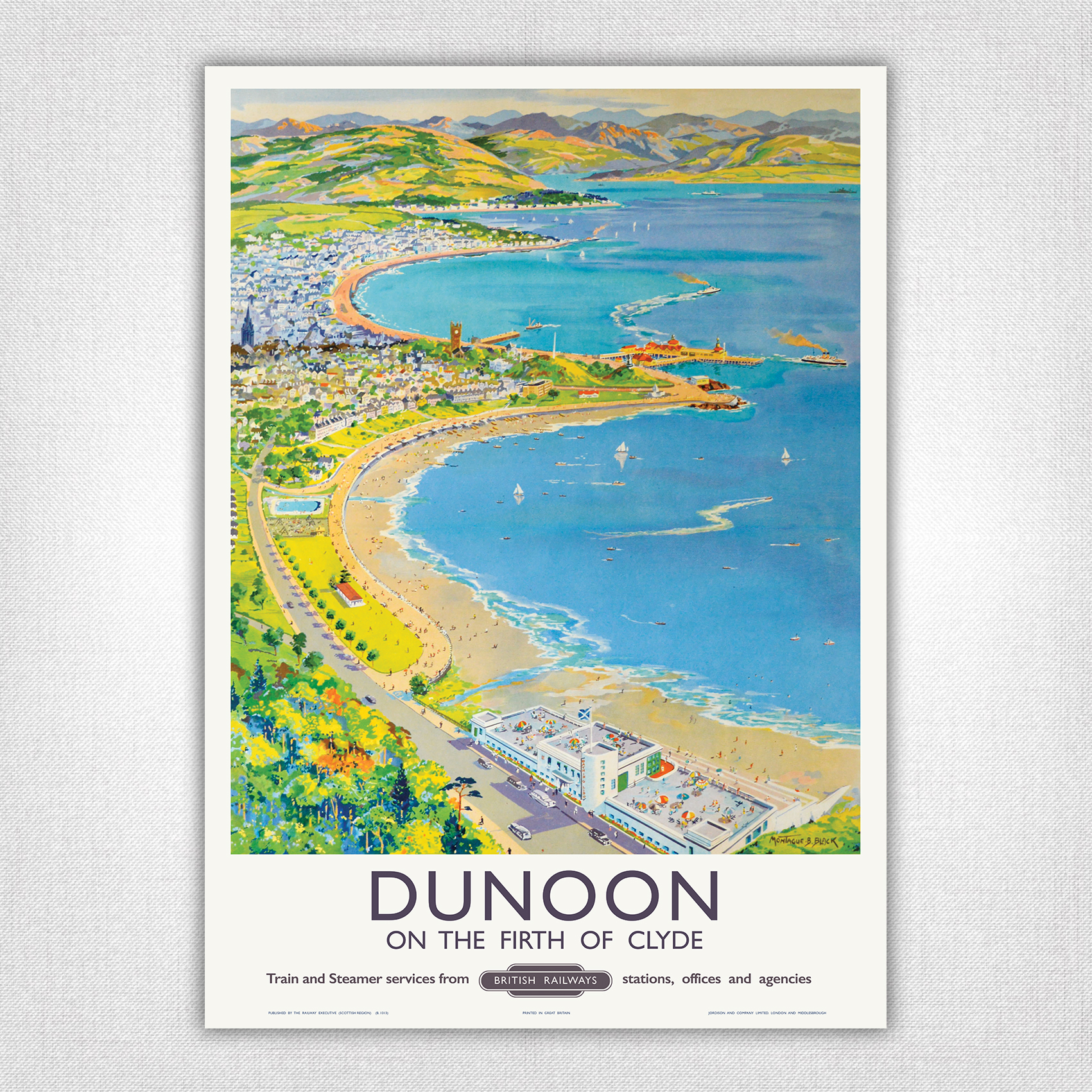
Dunoon poster on the Firth of Clyde – Montague Birrell Black – 1955
Here we offer a superb reproduction print of a vintage Dunoon on the Firth of Clyde poster. The artwork was created by the popular poster artist Montague Birrell Black, in the mid-1950s to promote the region as a seaside resort. In the 1920s and 1930s Dunoon was an incredibly popular holiday destination for Scottish workers. Its East and West beaches offered family fun and tours and trips on the eternally popular steamships that were common on and around the Firth of Clyde. Glaswegians described the trip as going ‘doon the watter’. Sadly, as the roads and railway networks improved and with the introduction of cheaper flights and package holidays to sunnier, warmer places abroad became accessible, many holidaymakers chose to go elsewhere, and Dunoon’s popularity waned. This vintage Dunoon poster was British Railway’s attempt to entice rail passengers to the region.
Burrell Black’s bird’s eye vantage point is from high above the West Bay beach. It takes in the magnificent view over the sands of the bay to Dunoon town with the towers of High Kirk Church and St John’s Church rising above the other buildings. Beyond the town, Burrell Black’s painting continues on to Dunoon’s East Bay, Holy Loch and Loch Long and the stunning mountain range of the Trossachs in the distance.
Beneath the magnificent, far-reaching view of Dunoon and beyond, the text on the Dunoon poster promotes its train and steamer services from stations, offices and agencies. It also suggests that interested customers should apply for “A fully illustrated Guide (6d) or free Folder and list of accommodation’. It goes on to suggest that interested rail passengers should ‘apply to the Secretary, Development Association, (Dept. P) Dunoon, Argyle.
Dunoon Lido on the Firth of Clyde
Dominating the poster’s image is Dunoon Lido. The magnificent, white rendered art deco building was located in the West Bay between Bullwood Road and the sea. It was constructed in the 1930’s replacing a Victorian structure known as the Gentlemen’s Bathing Station. At the time that the original Victorian building was constructed, it was not permitted for men and women to bathe together, let alone change together. The Victorian Ladies’ Bathing Station was built in the East Bay, which lies approximately one mile to the north. We reckon that was probably a safe enough distance!
Birrell Black has included the Saltire, a blue flag with a large white cross, which is the national flag of Scotland. The flag is billowing in the wind from the top of a flagpole on the top of the Lido’s half-round tower. Plans for the art deco structure originally included building a seawater pool on the shore, which would have had its water changed as the high tide flooded the shore. However, cost concerns expressed by the people of Dunoon led to the plan being cancelled. The lido became little more than changing rooms, showers, a place to sunbathe and an access point to the shore. Most of the structure was lost to demolition during the 1970s, with only the northern wall remaining. This was also demolished in 2010 to make way for the West Bay Swing Park playground.
Dunoon Pier
On the poster to the right of the town is Dunoon Pier. The famous local landmark was used by ferry companies such as the Caledonian Steam Packet Company and later David MacBrayne. The Dunoon ferry provided services to twenty-three destinations including Gourock, Wemyss Bay, Rothesay, Loch Lomond, Largs, Millport and Skye.
The earliest parts of the Victorian Pier at Dunoon date back to 1835. The first pier on the site was made of timber and constructed in 1835. A more substantial structure followed in 1841 after tourism to the town had increased. This second incarnation was destroyed in a storm three years later. It was rebuilt the following year and extended in 1867 by Campbell Douglas. The pier was extended to the current structure between 1896 and 1898. Dunoon Pier is now a Category A listed structure. Jutting out into the Firth of Clyde the Historic Environment Scotland has described Dunoon Pier as the best surviving example of a timber ferry pier in Scotland.
As can be seen from the image Dunoon bay was a busy stretch of water. The bay features steamers, speedboats, sailboats and fishing boats in a variety of shapes of sizes including a couple of Dunoon ferries. A selection of 1940s and 1940s vehicles are also shown driving along Bullwood Road. Buses, cars and delivery trucks make their way up and down the seafront road and dozens of day trippers and tourists can be seen walking up and down Victoria Parade, Dunoons the promenade.
Is Dunoon worth visiting?
Dunoon was an incredibly popular destination in the 1920s and 1930s when travel and tours around the Firth of Clyde were popular steamships were common around the Firth of Clyde. Glaswegians described the trip as going ‘doon the watter’. As the roads and railways improved and the introduction of cheaper flights and package holidays abroad many holidaymakers started to go elsewhere.
Today, the Scottish town of Dunoon is the main resort on the beautiful Cowal Peninsula. It is located in the south of Argyll and Bute, Scotland and is the maritime gateway to the Loch Lomond & Trossachs National Park. Dunoon is located on the western shore of the upper Firth of Clyde and is one of the region’s foremost resorts. It is built around the historic Castle Mound and is famous for its large Victorian pier, and its attractive promenade.
Other Dunoon Railway Posters
Dunoon’s popularity as a resort destination in the 1920s and 1930s is supported by the amount of vintage travel and railway poster designs that have survived the years. We are able to offer reproductions of several by a variety of poster artists of the time. A few of our favourites include the 1930 poster created by the artist W. Lee Hankey for the LNEr and LMS railway companies. The poster features a bird’s eye view of the town of Dunoon. The poster puts Dunoon Pier at the front and centre of the poster.
Another great Dunoon image was produced on John Littlejohn’s 1935 Dunoon poster. Once again an aerial viewpoint has been chosen by the artist. This Littlejohn poster was created for the London, Northern and Midland Railway company. In it, the artist has offered a view of the bay, town and pier. Compared to Hankey’s poster there is less prominence given to the pier and Littlejohn’s view is taken from further around the bay.
In 1955, the artist Montague Birrel Black created his own travel poster for Dunoon. Black’s image of the Scottish seaside resort is a reversal of the one on this listing. On this occasion, we are offered a view from West Bay back tøwards the tøwn of Dunoon with the East Bay in the distance beyond. Montague Birrel Black created many posters for British Railways. He created the artwork for at least two Dunoon Firth of Clyde posters. This second poster design offers a seagull’s-eye view from directly above the town itself and takes in the view across the Firth of Clyde towards Ardgowan, Inverkip and Weymus Bay and the mountains and Glens of the Clyde Muirshiel Regional Park, Scotland’s largest Regional Park.
How much is the Dunoon on the Firth of Clyde poster by Montague Birrell Black worth?
In this vintage travel poster, Montague Birrell Black opted for a seagull’s eye-view over Dunoon which offers a view of the impressive golden sands the town is known for. The poster hasn’t reached the status of being classed as rare yet, or particularly difficult to obtain in their original lithographic form. An original copy of this poster sold for $1000 in 2018. So, you can expect to pay around £1,000 for one in good condition.
It’s not a bad price for an original poster that was produced over 70 years ago. In fact, if you are considering starting an original poster collection, this poster would currently even be considered to be within the starting price range of between £500-£1000. There’s no argument from us, if you can find an original copy and can afford to buy it, you’re on to a winner. There’s nothing like owning an original vintage poster and they often make a great investment. Chances are in just a few years you’ll be able to sell it for more than you paid for it. Unfortunately, for most of us, an investment, even at the entry-level prices of the collectable poster isn’t even close to being a possibility. This is where our stunning high-quality reproductions come into their own. They cost a fraction of an original and look absolutely fantastic when they’re framed and hung on your living room wall.
Our superb reproduction print means you have a copy of this poster hanging on your wall in just a few days. Add a little bit of sun, sand, sea and Scotland to your home decor. Not so much ‘doon the watter’ as ”up oan th’ balla’. Order your Dunoon print today!