Concours D’Hydro-Aéroplanes poster print 1912
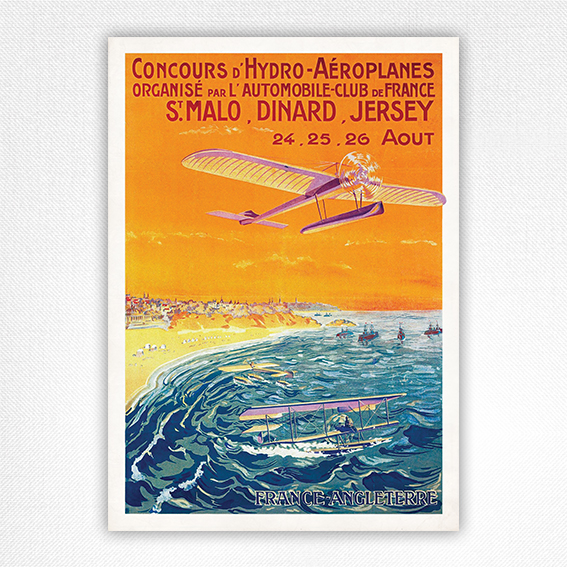
This is a vintage Aviation poster advertising an seaplane air-race organised by the Automobile Club of France. The superb Concours D’Hydro-Aéroplanes poster was created to promote an early pioneering air race that took place between St Malo, Dinard, and Jersey on 24-26 August 1912. The brightly coloured poster is certainly eye-catching. A warm orange, almost cloudless sky. The cold, choppy blue waters of the English Channel off the coast of St Malo. The poster depicts a Blierot-type plane racing in the air above the sea at Brittany. Two seaplanes are shown floating in the waters below. It’s a superb early aviation poster created by an anonymous artist.
The rare and historic vintage aviation poster reads, “Concours d’Hydro-Aéroplanes organisé par l’automobile-club de France de St Malo, Dinard, Jersey, 24, 25, 26 Aout”.
The St Malo-Dinard-Jersey seaplane air race.
The air race competition was held on 26th August 1912. It was the highlight of a three-day air show that included hydro-aeroplanes, now better-known as seaplanes. The race was contested on a 90-mile circular course between St Malo and Jersey. Five seaplanes entered the race, but one was unable to take off. The remaining four reached the refueling point in St Aubin’s Bay in JerseyA historic moment in Jersey’s aviation history because these competition planes would be the first aircraft to ever land on the small island of Jersey.
Charles T. Weymann in an Accident at Concours D’Hydro-Aéroplanes air show.
According to newspaper reports the air race was plagued with mishaps. Nine aircraft in the first four places suffered problems or fell into the sea. Fortunately, nobody was seriously hurt. Charles Weymann was the winner of the previous year’s Coupe Internationale d’Aviation. This year he was one of the pilots that took a dip in the briney.
An article in the Herald dated August 25th describes events. “After rounding the Grand Jardin light his Nieuport machine turned suddenly and the left wing dipped into the water. The spectators thought the hydro-aeroplane had plunged beneath the waves, but it did not capsize altogether, though it was swept by the water, which beat over the wings. A torpedo boat was sent to rescue the pilot and his two passengers, the Count de Montjou and a mechanician. Weymann’s plane sank while being towed back to calmer waters.
For most people, the accident would have been enough to put them off racing so soon after. But, those early pioneering aviators, those magnificent men in their flying machines, were made of different stuff. Fortunately, the uninjured Weymann had brought a second airplane with him to the competition and he had every intention of taking part in the race to Jersey just two days later.
Concours D’Hydro-Aéroplanes – the pilots and the planes
And enter he did. Along with eleven other pioneering pilots with their ground-defying machines were entered. The French aviator Labouret was flying in an Astra biplane and fellow countryman Marcel Chambenois piloting a Borel monoplane. Guillaume Busson entered his Deperdussin Monocoque racer whilst André Beaumont flew a Donnet-Leveque hydro airplane. Eugène Renaux flew a Maurice Farman bi-plane with Charles T Weymann flying his remaining Nieuport aircraft. Two Paulhans were entered into the race one by pilot Mesgulch and one by Frank Barra, he named Triad. Henri Molla flew a REP. The American aviator and aircraft manufacturer Thomas W Benoist flew in a Sanchez-Besa seaplane. And Rugere flew the race in a flying boat biplane made by Train-Astra.
Gnome or Renault engines are fitted to all machines with the exception of the Paulhan, which used a Curtiss engine, and all but one of the machines used Chauviere “Integral” propellers.
The Jersey course
On Monday, the third and last day of the meeting, the machines had to make a 50-mile flight to the island of Jersey, and in spite of the cold unpleasant weather Benoist on the Sanchez-Besa started out soon after 8 o’clock. It was quickly followed by the REP, Astra, Nieuport, and Farman. Renaux on the Farman returned after reaching Chausey, but the others continued, and were duly announced by wireless as having safely arrived. After an interval of about an hour the return flight started, the Astra biplane being the first machine sighted by the cruiser Gloire, which was on patrol. A system of scoring was drawn up, having a sliding scale in which points were awarded for first, second, and third places in each event, and, according to the number of passengers carried by the machine, and to the course over which the event was held.
And the winner is…
It was a close fought battle with Labouret in the lead as the planes approached the harbour. However, it was Weymann in the faster Nieuport monoplane thatwas able to extract a little extra power out of his engine to cross the line first, beating his opponent into second place. Molla in the REP and Benoist in the Sanchez-Besa were not far behind.
Weymann had won the “Jersey Speed Prize for winning Day Three’s course. His Nieuport VI-H airplane helped in complete it in 1 hour 40 minutes, flying to victory at an average speed of 60 mph (97 km/h).
But the real the winner is…
Weymann may have won the battle but he didn’t win the war. The final classing for the three-day race over the three courses saw Labouret finish three races and receive 15,000 Francs in prize money. The standings followed with Benoist and Molla also both finishing all three courses and receiving 10,000 and 6,0000 francs respectively. Prize money was awarded to the first six places. The last of which went to Farman in fourth earning 4,000 francs, Weymann in fifth getting 2,000 francs and sixth-placed Mesguich receiving 666 francs.
The pilots reported having had great difficulty steadying their craft and keeping a straight course however, as the vintage poster depicts, they could be reassured that their route was being patrolled by nine torpedo boat destroyers equipped with wireless telegraphs and was prepared to pick up any unfortunate airmen who ditched their aircraft.
The air show had been organised by the Automobile Club of France and it was reported that enthusiasts among the spectators expressed the view that before long hydro-aeroplanes would become as common as automobiles and small pleasure yachts.
Part of Jersey’s aviation history…
French pilot Jean Benoist and the Sanchez Besa seaplane he piloted, made history on the Saturday by becoming the first plane ever to land in Jersey. The plane touched down in the water off West Park on 26 August 1912. There was a huge commotion with the large crowd of spectators gathering around the ‘flying machine’. Unfortunately, the excitement led to Benoist’s return flight to Saint Malo being delayed and he slipped to third place in the race in which he was competing. The pilot feared for the safety of his flimsy machine as islanders scratched their names in the wings. American Charles Weymann had the fortune to land further down the beach at Beaumont, where he stayed 30 minutes, refuelled and hurried back to St Malo to claim first prize in the race.
The IslandWiki website has an article called ‘Jersey’s role in early air race’ which explains that the first aircraft to arrive in Jersey were competing in a series of air races centered on St Malo on the French coast to the south of Jersey island. It continues with a report about the three-day event from Contact!: The Story of the Early Aviators by Henry Serrano Villard. The article describes the event as follows.
SPEED CONTEST: In the summer of 1912 … a contest for speed, organised by the Automobile Club of France for August 24, 25 and 26 at St Malo on the coast of Brittany: two races in St Malo Bay, and one race to the British isle of Jersey in the Channel and back, with an obligatory stop at Jersey. No fewer than ten different makes of the machine were represented – for the most part, flown by pilots whose experience had hitherto been over land.
MONOPLANES: For the first time, monoplanes were entered in an aquatic contest, and crowds converged on St Malo to see what the single-surface machines could do. Five of the eleven entries were monoplanes, all of French make an REP, piloted by Henri Molla, the new standard-bearer of the house; the Nieuport of Charles Weymann, a model which had given America the Gordon Bennett cup in 1911; an Astra-Train, latest vehicle of Emile Train, the unlucky pilot in the Paris-Madrid catastrophe; a Borel, flown by Marcus Chambenois – the first monoplane ever to be fitted with floats; and the Deperdussin of Guillaume Busson. To the delight of the monoplane’s supporters, Molla’s REP showed its tail to all other competitors in the opening day’s events.
BIPLANES: The biplanes, however, had to be reckoned with on a point system of scoring. These included the Maurice Farman of Eugene Renaux; a Donnet-Leveque flying boat, with Jean Conneau at the controls; two Paulhen-Curtiss Triads, piloted by Frank Barra and a new flyer named Mesguich; the Sanchez-Besa of Jean Benoist; and a heavy Astra tractor, flown by Rene Labouret. It was a first-day victory on points for the Astra, able to carry two passengers with ease, this Wright-licensed machine was a high scorer with the extra load.
THE SECOND DAY: Whether the event could continue on the second day was in doubt – A strong wind had sprung up and the sea had roughened considerably. Taxiing against the waves, some machines were damaged; others could not get off the water or threatened to capsize. Six planes finally took part in the day’s trials. Those that managed to become airborne demonstrated that a double float, in catamaran style, afforded more stability than a single float. An exception was the REP; with its broad single pontoon it rode the swells without apparent difficulty, and for the second time, Molla recorded the fastest time over the course. Again, however, a biplane was the winner on points, when the Sanchez-Beza of Benoist took off with three passengers and flew steadily into the freshening wind.
JERSEY: On the last day, angry whitecaps appeared on the sea waves, and the wind stiffened once more. Fortunately, for the race to Jersey and back, it was permissible to land and take off from the sheltered harbour areas. Speed from point to point, rather than the number of passengers, was what counted. Weymann won the race in his Nieuport, showing again that monoplanes were the swiftest craft on the water as well as on land. The high scorers of the event were the biplanes: the Astra in first place and the Sanchez-Besa in second.
How much is an original 1912 Concours D’Hydro-Aéroplanes poster worth?
The Concours D’Hydro-Aéroplanes 1912 vintage aviation poster is an exceptionally rare item. There are not thought to be many examples of the original lithographic print to have survived and even less in great condition. It is also a fact, that collectors of aviation memorabilia, especially from the early days of flight, are known to be a bit, well… let’s just say, they take their poster collecting seriously. For these two reasons it probably won’t come as a surprise that this 1912 HydroAeroplane Competition poster is highly sought after. There was a copy online at the time of listing that showed colour fading, light horizontal folds and corner creases and it still sold for almost £4,000. In Grade A condition who knows what it would fetch? Well in excess of £5,000 we’d wager.
There’s no argument from us, if you can find an original copy and can afford to buy it, you’re on to a winner. There’s nothing like owning an original vintage poster and they often make a great investment. Chances are in just a few years you’ll be able to sell it for more than you paid for it. Unfortunately, for most of us, an investment, even at the entry-level prices of the collectible poster isn’t even close to being a possibility. This is where our stunning high-quality reproductions come into their own. They cost a fraction of an original and look absolutely fantastic when they’re framed and hung on your living room wall.
Aviation posters don’t get much older than this. Our superb reproduction print is of a poster that old, that in the aviation timeline, is closer to the period of Zeppelins, Airships and Balloons than it is to the Golden age of flight. It was originally produced just nine years after the Wright Brothers first controlled flight in North Carolina. Three years after Louis Blierot’s successful flight across the English Channel. And eighteen years before Amy Johnson flew solo from England to Australia.
If you love aeroplanes and air shows or have an interest in early aviation, or work as a pilot, trolley dolley or baggage handler, you’ve just got to love this poster. If you live in Jersey, Dinard or St Malo then it will have even more resonance. This poster will add a touch vintage aviation class to your home decor. It’s plane and siimple, it’ll look great in your lounge, landing or cabin and your crew will love it!. Don’t delay, order yours today. It’ll be at your destination faster than you can get to the checking-in desk at Heathrow!