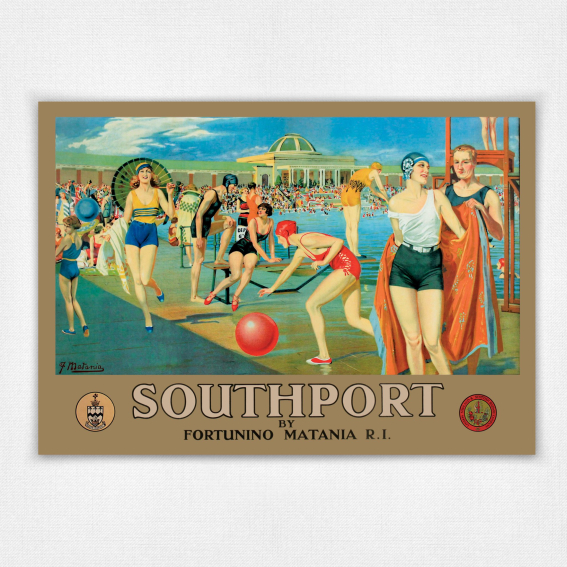
Southport Sea Bathing Lake poster – Vintage Southport travel poster – Fortunino Matania – c1930
In the 1930s, the seaside town of Southport was still a thriving and cosmopolitan resort. Just how refined Southport was is depicted in three stunning posters by the Italian artist Chevalier Fortunino Mantinia. The stunning Southport Sea Bathing Lake poster, Southport For a Holiday in Wintertime poster and the Southport Venetian Bridge poster depict the north west coastal town as a glamourous holiday destination.
Southport’s story as a tourist town began in the late 18th century when it was a small but flourishing fishing hamlet. At that time, doctors recommended bathing in the sea to help cure aches and pains, and it became fashionable for the well-to-do to desert inland spa towns in favour of seaside visits. Southport, with its access to the salt sea waters, quickly gained recognition as a health resort.
Its early success was down to the fact that the town had easy access to the canal system, primarily the Leeds and Liverpool canal. This enabled early tourists to arrive from Liverpool, Manchester, Bolton, Wigan, and other areas. By 1820, Southport was already welcoming over 20,000 visitors annually.
The arrival of the railways in the mid-19th century marked a pivotal change, further boosting Southport’s accessibility and attracting even more tourists from nearby cities. This railway connectivity allowed the town to flourish as a resort destination, offering not only sea bathing but also a wealth of leisure and entertainment options. As the town grew it earned a glowing reputation as a refined seaside resort compared to its bawdier coastal neighbour, Blackpool.
Southport’s growth continued throughout the Victorian era, leading to the construction of grand hotels, promenades, and beautifully landscaped gardens. The town’s architecture, characterized by ornate Victorian and Edwardian buildings, remains a testament to this era of opulence.
While Southport’s transformation into a tourist town continued to evolve over the years, it retained its historic charm with attractions like the iconic Southport Pier and beautiful floral displays. In modern times, it has adapted to contemporary tastes, offering modern shopping districts, diverse dining options, and a thriving arts scene.
As the seaside town’s popularity increased, there was a need to add new features and attractions to entice more holidaymakers. In 1914, Southport built its famous Sea Bathing Lake. It became an extremely popular place to be seen by visitors from all over the country.
In 1928 the cold and draughty lido was replaced by the beautiful Southport bathing lake. A new and improved pool was constructed on Princes Park. The aim of the lake was to provide a large open-air sea bathing lake for mixed bathing. It was 330ft long and 212ft wide and cost £70,000 to build. It could seat more than 2,500 spectators with room for up to 650 bathers. However, vintage photographs show that it was often so full, that there would be standing room only.
Fortunino Matania’s stunning Southport travel poster
It is Southport’s new Seawater Bathing Pool that the Italian artist Fortunino Matania illustrated to stunning effect for this 1930s Southport railway poster. Promoting rail travel to Southport for Cheshire Lines and the London, Midland and Scottish railway company, the poster goes someway to show how popular Southport lido was.
Matania’s circa 1930 artwork is a vibrant and captivating snapshot of a bygone era. In the beautifully crafted colored lithograph, Southport Lido comes to life, exuding an air of youthful exuberance and leisure.
At the heart of the poster, we find a charming scene at the pool’s edge, where a group of stylish young adults in their twenties revel in the joys of a sunny day at the lido. Dominating the foreground, a vivacious woman in form-fitting blue shorts and a sleeveless white top, one strap carelessly slipping off her shoulder, extends her arms behind her. Here, a gallant man attends to her, gracefully draping a gown upon her shoulders, epitomising the carefree spirit of the era.
Nearby, a spirited young lady, dressed in a striking red swimsuit and matching cap, chases a vibrant red beach ball with unbridled enthusiasm, adding a playful touch to the scene. Just a few steps away, another woman dons an ensemble of yellow and blue, strolling elegantly along with a parasol, lending an air of sophistication to the proceedings.
Meanwhile, a casual yet engaging conversation unfolds between a dashing gentleman, dressed in a sleek black one-piece swimsuit and a matching bathing cap, and a coyly seated woman perched on a diving board. Their interaction captures the essence of flirtatious charm and leisurely camaraderie that was emblematic of the era.
Beyond this central tableau, the poster reveals a bustling backdrop teeming with life and energy. Crowds of people come together to savor the pleasures of the lido, adding to the sense of community and shared enjoyment. A picturesque pavilion stands as a testament to the architectural grace of the time, framing the entire scene with a touch of nostalgia.
This Southport Sea Bathing Lake poster, a masterpiece by Fortunino Matania, transports us back in time, offering a vivid glimpse into a world where youth, elegance, and leisure converged at the edge of a sun-kissed swimming pool, creating a timeless image of joy and togetherness.