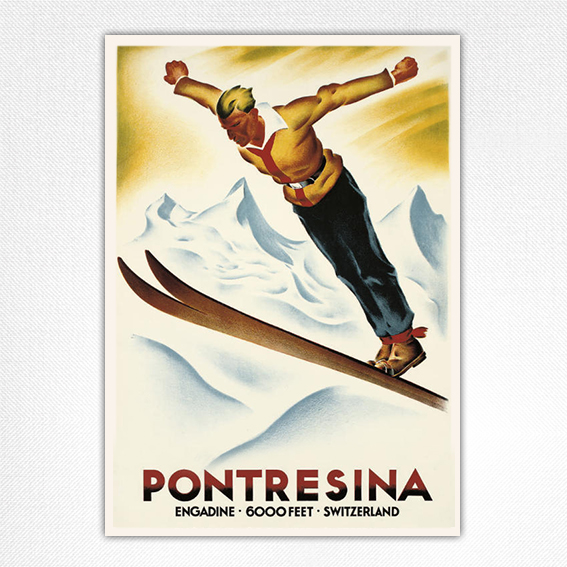
This Carl Moos Pontresina ski poster, created in 1928 serves as a captivating promotional piece for the magnificent mountain ski resort nestled in the Engadine region of Switzerland. The vintage Swiss skiing poster was designed to entice visitors to this stunning alpine destination, capturing the essence of the Pontresina resort’s allure during the 1920s.
Carl Franz Moos’s artwork showcases a daring ski jumper suspended in mid-air, frozen in a moment of exhilarating flight. The skier’s pose reflects the techniques of the era, depicting the Kongsberger ski jump technique. Dressed in the typical skiing attire of the time, the athlete wears a white shirt, a mustard-colored cardigan, black trousers, and sturdy ski boots. Unlike modern safety regulations, there is no evidence of health and safety clothing or ski helmets, underscoring the adventurous spirit of the time.
The jumper’s posture is notable, with the upper body bent at the hip, reminiscent of an eagle with outstretched wings. This technique, known as the Kongsberger technique, allowed ski jumpers to achieve remarkable distances during the 1920s, extending jumps from around 45 meters (148 feet) to over 100 meters (330 feet). It remained the prevalent technique until the 1950s when it was superseded by the Windisch and Däscher techniques.
The picturesque Engadine landscape forms the backdrop of the poster, with the Bernina Mountains’ majestic peaks rising dramatically in the distance. The snow-covered terrain beautifully contrasts with the warm golden glow of the sun in the skies above, creating a sense of serene beauty and the promise of thrilling winter adventures. The poster effectively captures the wild and untouched nature of the Engadine, enticing viewers with its unspoiled and idyllic alpine scenery.
Overall, the Pontresina poster by Carl Franz Moos encapsulates the essence of the ski resort, presenting it as a captivating and thrilling destination for winter sports enthusiasts. The airborne ski-jumper, the breathtaking Engadine landscape, and the prominent Bernina Mountains serve as powerful visual elements, inviting viewers to embark on an unforgettable alpine experience in the height of luxury and natural beauty.
Skiing and Ski Jumping at Pontresina
Pontresina, a mountain village nestled in a picturesque Upper Engadine side valley, offers a captivating blend of natural beauty and cultural heritage. At an elevation of 1,805 meters, Pontresina enjoys abundant sunshine and protection from the wind, creating an idyllic setting for outdoor enthusiasts and those seeking tranquility. The village is flanked by the majestic Bernina massif, home to the renowned peaks of Piz Palü and Piz Bernina, the latter being the highest summit in the Eastern Alps, standing tall at 4,049 meters.
Stepping foot in Pontresina feels like stepping back in time, as the charm of traditional Engadine houses and the elegance of grand Belle Epoque hotels evoke a sense of nostalgia for an era when life seemed more orderly. The village’s rich history and mountaineering traditions add to its allure. Pontresina has been a hub for winter sports since the early 20th century when the first ski jumping hills were constructed by enthusiastic youngsters.
Among these early ski jumping hills were the Clüx-Schanze, located near the present-day valley station of the Languard ski lift, and the Piccolischanze, situated below the Spaniola tower. These hills allowed jumps of around 20 to 30 meters, providing a thrilling experience for the young ski jumpers of that time. In 1907, construction began on the Bernina-Sprungschanze in Roseg Valley, and by the winter of 1912, it officially opened as a 40-meter hill.
In the 1920s, under the leadership of Luigi Costa, the decision was made to construct a larger ski jumping hill on the left side of Roseg Valley (Val Roseg), with the goal of enabling jumps of up to 80 meters. The Skiclub Pontresina spearheaded this ambitious project, and in 1925, the new facility was inaugurated with an international competition. Over the following years, Pontresina became a host to numerous prestigious events, often holding up to four competitions in a single winter season. The international competitions held in Pontresina during this period were highly regarded in Europe, according to the jumpers who participated.
In 1928, Swiss ski jumper Bruno Trojani made history by becoming the first European jumper to surpass 70 meters in distance. Notably, Adolf Badrutt achieved a remarkable world record distance of 75 meters in 1930. However, after 1948, the last competition took place on Berninaschanze, marking the end of an era. In the post-World War II years, the 40-meter ski jumping hill located above the train station remained in use until the 1960s, preserving the legacy of ski jumping in Pontresina.
Pontresina, with its stunning surroundings and blend of tradition and elegance, continues to captivate visitors seeking both serenity and adventure. Whether one seeks the peace and quiet of a tranquil mountain village or the thrill of outdoor pursuits, Pontresina offers an unforgettable experience that connects the present with a bygone era. This vintage Carl Moos Pontresina ski poster encapsulates the essence of Pontresina, offering a glimpse into a world of elegance, adventure, and natural beauty. It appeals to skiers, snow jumpers, and winter hikers alike, as it invites them to immerse themselves in the rich heritage and captivating surroundings of this remarkable alpine destination. Owning the poster allows individuals to bring a piece of Pontresina’s allure into their homes, serving as a source of inspiration and a testament to their love for winter sports and the captivating landscapes that define them.
How much is an original Carl Moos Pontresina poster worth?
This classic, vintage Pontresina skiing poster created by the renowned Swiss poster artist Carl Moos is greatly admired and highly sought after. As such it can command prices as high as the skijumper on the poster print, and they seem to be soaring ever higher. One original lithograph Pontresina poster was placed in auction in a grade B+ condition and scarred with tape marks which sold for £2,400 in 2007. Two years later an grade A version came to market achieving a jump to £5,625. However, more recently a Grade A original lithograph printed by Fretz Bros., Ltd, Zurich, soared to over £13,000.
There’s no argument from us, if you can find an original copy and can afford to buy it, you’re on to a winner. There’s nothing like owning an original vintage poster and they often make a great investment. Chances are in just a few years you’ll be able to sell it for more than you paid for it. Unfortunately, for most of us, an investment, even at the entry-level prices of the collectible poster isn’t even close to being a possibility. This is where our stunning high-quality reproductions come into their own. They cost a fraction of an original and look absolutely fantastic when they’re framed and hung on your living room wall. Order your reproduction Carl Moos Pontresina ski poster today.