
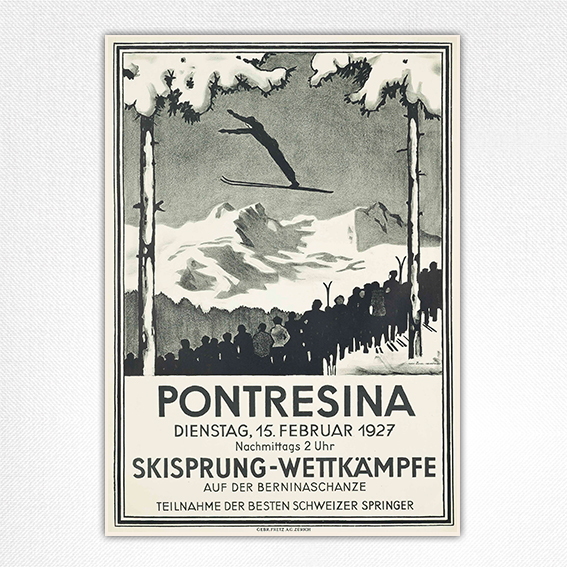
The 1927 Pontresina Skisprung-Wettkampfe Skiing poster is an early example of ski jumping art. The poster’s illustration was created by the German artist Edwin Hermann Richard Henel. The vibrant black and white image depict a ski jumper soaring through the air against the backdrop of the Bernina Alps. The famous mountain range includes the highest mountain of the cantonPiz Bernina and its smaller neighbours Piz Zupó and Piz Palü. The interest the sport generated in those early, quite frankly, daredevil days, of the sports is highlighted by the crowds featured lining the edge of the Berninaschanze.
This particular poster was created to promote the 1927 Pontresina Skisprung-Wettkampfe. It was a new International Ski Jumping Competition held at the Pontresina Ski resort at Val Roseg. The event was one of the most prestigious competitions of its time and drew skiers from all over the world. Today, the Pontresina ski-jumping poster is a highly sought-after collector’s item. It is an excellent example of skiing poster art of the era and is reminiscent of a series of posters created by Carl Moos around 1926 to promote the more famous nearby resort of Davos. The poster is a reminder of the golden age of competitive ski-jumping.
The text on the poster reads ‘Pontresina. Dienstag, 15 Februar 1927. Nachmittags 2 Uhr. Skisprung-Wettkämpfe auf der Berninaschanze. Teilnahme der Besten Schweizer Springer.’ Which translates into English as ‘Pontresina. Tuesday, 15 February 1927. Two o’clock in the afternoon. Ski jump competitions on the Bernina Hill. Participation of the best Swiss ski jumpers’
Ski jumping at Pontresina
The Bernina-Schanze ski ramp has played a crucial role in the development of early winter sports and is famous in the world of Swiss ski-jumping. As early as 1907, construction began on the Engadine ski jump slope and when it was completed it allowed ski jumps of around 20-30 meters.
The Berninaschanze ski jump was officially opened in the winter of 1912 as a 40 metre hill. It was a huge success. In fact, it was so successful that in the 1920s a second, larger ski jump was built on the left side of Roseg Valley. The new ramp was intended to allow ski jumpers to make ski jumps of up 80 meters possible.


