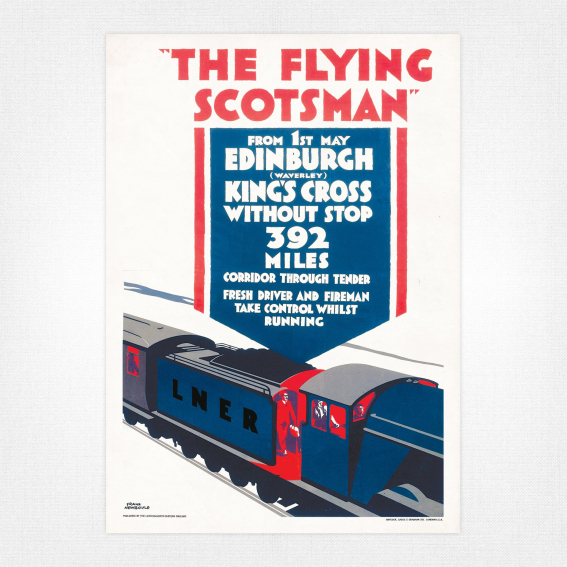
The Flying Scotsman poster Without Stop poster – Vintage LNER Railway Poster – Frank Newbould 1928
Not all the advertising for the Flying Scotsman featured full-colour images of the train racing through the British countryside. In 1932, the renowned poster artist Frank Newbould was commissioned by the London and North Eastern Railway (LNER) to design a poster promoting the forthcoming specially designed corridor tenders. The ground-breaking feature marked a significant leap in train travel, allowing for a seamless transition of control during the extensive 392-mile journey. Unlike conventional setups, this design enabled a change of driver and fireman while the train was still running.
The poster, adorned with striking blue, white, and red text and accentuated by a bold arrow pointing to the coal tender, proudly announced a revolutionary service starting from May 1st. Trains departing from the historic Edinburgh Waverley station and destined for the bustling hub of King’s Cross would now cover the entire distance without any stops, ensuring swift and efficient travel between the two iconic cities.
This poster not only served as a promotional tool but also symbolised an era of progress and efficiency in rail transportation. It showcased the railway industry’s dedication to enhancing passenger experience, making long-distance travel more comfortable, efficient, and reliable. Although the cab of the famous locomotive as well as one of its train’s many carriages are visible, the poster focuses our attention on the innovative coal tender. The passageway, which ran along the right-hand side of the tender, was 5 feet (1.52 m) high and 18 inches (0.46 m) wide. It also had an increased coal capacity of nine tons instead of the usual eight.
Looking like a ribbon on a medal, a large blue white, and red arrow directs our attention to the replacement driver making his way through the corridor tender and onto the engines footplate. The fresh driver and the front of the tender are depicted in warm red as they are lit by the glow of the engine’s furnace. The ribbon displays text that reads: From 1st May Edinburgh Waverley King’s Cross Without Stop 392 Miles. Corridor through Tender. Fresh Driver and Fireman take control whilst running.
At 10am on May 1, 1928, locomotive No. 4472 led the inaugural non-stop train from London to Edinburgh. It successfully achieved the feat by covering the 392-mile (631 km) distance without any stops, setting a record for a scheduled service during that era. The special corridor tender was a success. After that, non-stop runs became commonplace and by 1932 and the end of the limited speed agreement, the London to Scotland journey time had come down to 7 hours 30 minutes, and by 1938 to 7 hours 20 minutes.
Other Flying Scotsman Railway Posters
The Flying Scotsman passenger train service began in 1862 as the Special Scotch Express. The Flying Scotsman train was officially named in 1923 after the passenger service from London King’s Cross to Edinburgh Waverley on the East Coast mainline. Its unmissable green livery, record-breaking achievements, and iconic railway posters soon made the train extremely popular with the British public.
The Flying Scotsman continues to be a symbol of British engineering and a beloved piece of railway history, captivating enthusiasts and tourists worldwide. This famous train has left its mark in various forms of media, gracing the pages of books, the screens of films, and even adorning coins, postage stamps, and jigsaw puzzles. Its iconic presence extends to everyday items like cups, mugs, and coasters, making it a beloved symbol that permeates both history and popular culture.
Vintage posters featuring the Flying Scotsman are especially popular among collectors due to their rarity and nostalgic appeal. These posters capture the essence of the train and are highly valued by those who appreciate history and art. The posters are a testament to its enduring legacy, the Flying Scotsman continues to inspire and captivate generations, becoming a cherished symbol of the golden age of rail travel.
Some of our favorite Flying Scotsman posters include an anonymous poster for the LNER who in conjunction with the Cunard shipping line produced a poster to encourage transatlantic travel from America and Canada to the British shores and onto the Continent. The Cunard LNER poster depicts the famous train waiting patiently on Liverpool docks while its passengers disembark from the RMS Aquitania.
Another well-known and popular poster was produced in 1932 by the British artist A.R. Thomson. The Take Me By Flying Scotsman poster depicts a small child standing on a railway platform looking up at a train driver in his cab. The poster mimics Southern Railways ‘Early Holiday poster‘ by Charles Brown. However, the size of the child compared to the locomotive, and the train driver needing to use a megaphone to communicate with the child, seems to be a playful way to show that LNER trains were bigger and faster than Southern’s.
Leo Marfurt‘s 1928 Flying Scotsman poster is an Art Deco classic that barely features the famous locomotive or train. Instead, the bright and contemporary graphic, almost abstract design depicts a large crowd of passengers leaving the platform having alighted the train whilst others wait patiently to board. The image accompanies the message that the train leaves Kings Cross station in London at 10 a.m. every weekday.
A personal favorite features the iconic train winding its way through the rugged Scottish scenery in the Monessie Gorge in Inverness-shire, Scotland. The stunning By Rail to the Highlands print was created by the renowned artist Terence Cuneo who was renowned for his incredible railway posters and fine art paintings.
For our final highlight, we have chosen a series of posters that were created to celebrate the Flying Scotsman turning 100 years old. Each of the twenty Centenary posters marks one of the mainline centenary runs that took place between March and December 2023. The runs include East Lancashire, Royal Duchy, Keighley and Worth Valley, Cardiff Express, the Cheshireman, the Portsmouth Flyer, the Salisbury Express, the East Coast Mainline, and the Highland Express.
We currently list over 200 vintage railway posters in our collection with new ones introduced on a regular basis. More than a dozen of these include superb reproduction prints and original Flying Scotsman posters. Take a trip over there and see where the journey takes you!