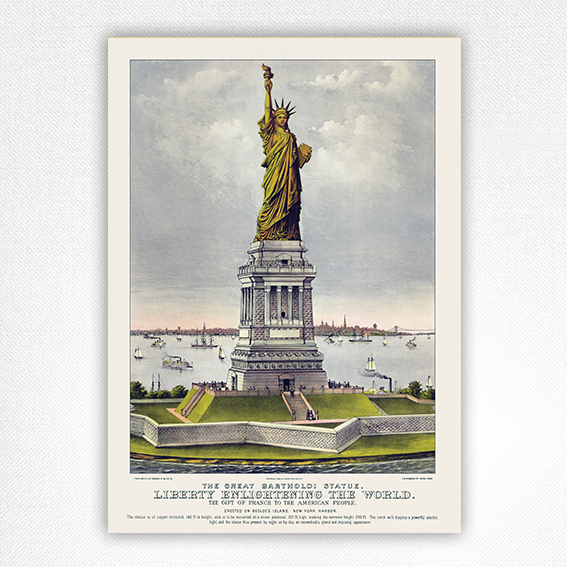
Statue of Liberty poster The Great Bartholdi Statue poster – 1885
This fabulous Statue of Liberty poster was created twelve moths before the National monument, a gift of France to the American people,was designated. The poster was published by the American printing firm Currier & Ives.
Between 1835 and 1907, Currier and Ives dominated the American lithographic printing scene from their base in New York City. They were known for their prolific output of high-quality prints, often made from paintings by renowned artists. These prints were typically monochrome and hand-colored, making them both visually appealing and affordable. Currier and Ives proudly called themselves “the Grand Central Depot for Cheap and Popular Prints” and marketed their lithographs as “colored engravings for the people.”
One of their most popular prints was an 1885 depiction of the Statue of Liberty, then known as the Great Bartholdi Statue. This vintage Statue of Liberty poster captures the statue in all its grandeur, standing tall on Bedloe’s Island amidst the bustling New York Harbor. The scene also offers a glimpse of the surrounding cityscape, with Manhattan, Brooklyn, and New Jersey visible in the background.
Currier and Ives produced numerous prints of the Statue of Liberty posters throughout the years, each offering a unique perspective on this beloved American landmark. These prints not only documented the statue’s construction and evolution but also served as a testament to its growing symbolic importance.
The Statue of Liberty was a gift from France to the United States, commemorating the centennial of American independence and the enduring friendship between the two nations. Although originally named after its sculptor, Frédéric Auguste Bartholdi, the statue quickly became synonymous with the universal concept of liberty itself.
Despite Bartholdi’s immense contribution to this enduring symbol, his name remains less recognised than the statue he created. Perhaps, in a way, this anonymity reflects the very essence of the monument – a beacon of hope and freedom that transcends individual personalities and stands as a testament to collective ideals.
France would be responsible for creating the Statue and assembling it in the United States while the American people would fund and build the pedestal.
After the Statue was presented to Levi P Morton, the U.S. minister to France, on July 4, 1884 in Paris, it was disassembled and shipped to the United States aboard the French Navy ship, Isère. The Statue arrived in New York Harbor on June 17, 1885, and was met with great fanfare. Unfortunately, the pedestal for the Statue was not yet complete and the entire structure was not reassembled on Bedloe’s Island until 1886.
The star-shaped granite pedestal is known as Fort Wood, and today houses the Statue of Liberty Museum, and provides a sturdy foundation for the statue’s impressive height. Rising 152 feet (46 meters) tall and 62 feet (19 meters) square at the base the platform offers two viewing platforms for visitors to soak in the breathtaking views of New York Harbor and the city skyline. There are three viewing platforms inside the statue. The first is at the base, offering a close-up view of the neoclassical details. The second is on the pedestal’s balcony, with stunning views of New York Harbor. The third, and most exclusive, is inside the crown, accessible only by climbing a 354-step spiral staircase. From here, you can enjoy breathtaking panoramic views of the city and beyond.
Bartholdi’s design encompassed a great deal symbolism: Her crown features seven points, representing the seven seas and the continents. This signifies its universality and welcoming all to America. The crown also has 25 windows with golden rays radiating outward, symbolizing hope and enlightenment spreading across the globe. Liberty’s tablet is inscribed with July 4, 1776 in Roman numerals, noting American independence, and to symbolise the end of slavery, Bartholdi placed a broken shackle and chains at the Statue’s foot.
The Statue of Liberty’s torch is one of her most recognisable features. Made of thin copper sheets hammered over an iron frame, it holds a golden flame with 15 points, representing the sun’s rays and the torch’s role as a beacon of enlightenment. Upon closer inspection of the golden torch in this stunning early Statue of Liberty poster it is possible to make several people at the statues once highest viewing platform.
Sadly, the torch has been closed to the public since 1916, when the Statue of Liberty was hit by a nearby explosion that ended up damaging parts of its structure. Not far from the statue, Black Tom Island was being used to create munitions that the United States was sending to England during World War I. The explosion created so much damage that glass windows in Manhattan shattered and todate, the torch has never been repaired enough to provide access for the public.
The Statue of Liberty poster reads; The Great Bartholdi Statue. Liberty Enlightens The World. The Gift of France to the American People. Erected on Bedloe’s Island, New York Harbour. It continues: The statue is of copper-bronzed, 148ft in height, and is to be mounted on a stone pedestal 150ft high, making the extreme height 298ft. The torch will dislay a powerful electric light, and the statue thus present, be night as by day, an exceedingly grand and imposing appearance.
This majestic figure depicted in this Statue of Liberty poster has been seen by millions of immigrants arriving in America, welcoming them with her torch held high and a promise of new beginnings.