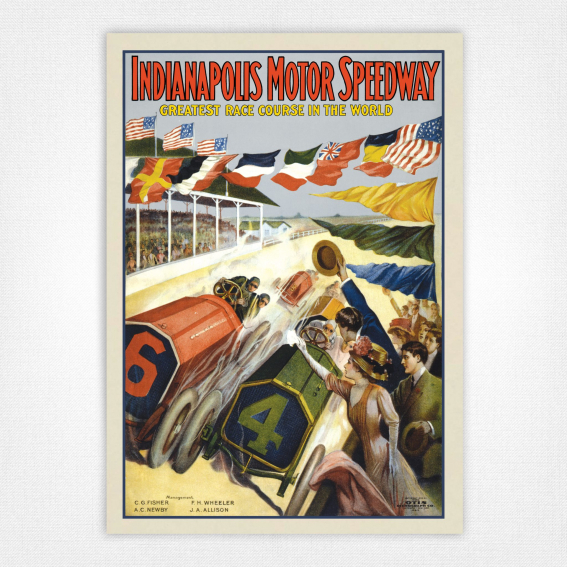
This extraordinary Indianapolis Motor Speedway poster, originally created to promote the newly constructed Indianapolis Motor Speedway in Speedway, Indiana, captures the very essence of early 20th-century motor racing. It proudly self-dubbed the circuit the “Greatest Race Course in the World.”
This dynamic motor racing poster, produced in 1909 – the same year the track opened – holds the distinction of being the first-ever poster for the Indianapolis racetrack. Its vibrant, colourful image makes it one of the earliest surviving and arguably the rarest motor racing posters in existence. The artwork vividly portrays a dramatic race scene: a selection of sleek sports cars thunder down the final straight, hurtling past a grandstand brimming with exhilarated spectators.
More fans at the finish line cheer wildly, waving hats and handkerchiefs as the two lead cars fiercely vie to cross the line first. To underscore the international flair of the Indianapolis Motor Speedway’s events, the anonymous artist cleverly depicted a cascade of international flags, strung like celebratory bunting across the racetrack. As the Indianapolis Motor Speedway poster proudly proclaims, the Indianapolis Speedway is indeed the “Greatest Race Course in the World.”
The Birth of a Legend: Indianapolis Motor Speedway’s Origins
The infamous racetrack, a place now synonymous with the iconic imagery you see on many an Indianapolis Motor Speedway poster, was built in 1909. It became only the second purpose-built banked oval race track globally, preceded solely by England’s Brooklands circuit. It also holds the distinction of being the third-oldest permanent automobile race track worldwide, behind Brooklands and the Milwaukee Mile – the latter being the oldest operating motor speedway. The legacy captured on the Indianapolis Motor Speedway poster truly began here.
Considered relatively flat by American standards, the track is a 2.5-mile (4.0 km) rectangular oval. Its dimensions have remained essentially unchanged since its construction, featuring two 5/8-mile (1,000 m) long straightaways, four geometrically identical 1/4-mile turns, connected by two 1/8-mile “short chutes” between turns 1 and 2, and between turns 3 and 4.
The First Race at the Indianapolis Motor Speedway
The first motorsport event at the track, sanctioned by the Federation of American Motorcyclists (FAM), comprised seven motorcycle races on 14 August 1909. This was initially planned as a two-day, 15-race program, but it concluded prematurely due to concerns over the suitability of the track surface for motorcycles.
On 19 August 1909, fifteen car manufacturers and their teams arrived for practice. The track surface, a mix of dirt, oil, and tar, was already showing ruts and holes on the bends. Speedway workers oiled and rolled the track before opening the gates to the public. An estimated fifteen to twenty thousand spectators turned up, paying just $1 for entry.
The first day of car racing saw four finishes and two land speed records. However, safety concerns led AAA officials to consider cancelling the remaining events. The organiser promised repairs by the next day, convincing officials to let the show go on. The second day saw 20,000 spectators, no major incidents, and more speed records broken.
On the third day, 35,000 spectators arrived for the grand finale, a planned 300-mile (480 km) race. However, a series of accidents, including three deaths during the race (adding to those from the previous two days), led to its cessation. The AAA subsequently boycotted future events until significant track improvements were made.
The “Brickyard” and the Indianapolis 500
Within a month, the racetrack underwent a transformative resurfacing. Five Indiana manufacturers supplied 3.2 million 10-pound (4.5 kg) bricks, each hand-laid over a 2-inch (51 mm) sand cushion, then levelled and mortared. Simultaneously, a 33-inch (840 mm) tall concrete wall was constructed in front of the main grandstand and around all four corners to protect spectators.
The final brick laid was made of gold, embedded in a special ceremony. Even before completion, locals affectionately nicknamed the track “The Brickyard.” Today, just 3 feet (0.91 m) of those original bricks remain exposed at the start-finish line.
During the 1909 and 1910 seasons, the Indianapolis Motor Speedway hosted numerous smaller races, but interest waned significantly. IMS owners Carl Fisher, James Allison, Arthur Newby, and Frank Wheeler conferred, deciding on a bold new direction for the following year. They initially considered a 24-hour competition, which would have predated the Le Mans 24-hour race by twelve years. An alternative was a 1000-mile endurance race with a substantial $25,000 purse, hoping to attract national and international interest.
Manufacturing companies favoured the endurance race, seeing it as an excellent way to test and prove their cars’ performance. The Speedway team weighed what would benefit spectators and participants most. They concluded that while a 24-hour race was technically feasible, ticket-buyers would likely depart before its conclusion.
Instead, they settled on a 500-mile endurance race, starting around 10 am and finishing in the late afternoon, with a prize fund of approximately $30,000, meaning the winner could expect to pocket as much as $12,000.
The inaugural event took place on 30 May 1911. As anticipated, it garnered widespread interest from American and European racing teams and manufacturers. Forty-six cars entered, with the field predominantly American drivers (36 out of 40). Other nations represented included Italy, Norway, France, and Switzerland. Despite the American-dominated driver lineup, the cars themselves were a diverse international mix, including Lozier, Fiat, Mercedes, Marmon, Simplex, and many more.
On race day, forty cars lined up five abreast before Carl Fisher led them out in the Stoddard-Dayton pace car for the first known mass rolling start in automobile racing. With a wave of a red flag, the race began. American driver Johnny Aitken in a National took the early lead, holding it for five laps before Spencer Wishart in his Mercedes overtook him.
Wishart’s lead was short-lived, as David L. Bruce-Brown in a Fiat then dominated the first half of the race. Tragedy struck on lap 12 when Arthur Grenier’s riding mechanic Sam Dickson became the first fatal casualty of the Indianapolis 500.
Around the halfway mark, Ray Harroun passed Bruce-Brown in his self-designed “Marmon Wasp.” Harroun and co-driver Cyrus Patschke led for 123 of the 200 laps (88 by Harroun, 35 by Patschke), the most time spent in the lead among the seven leaders. Three-quarters into the race, an intense battle raged between Harroun and fellow American Ralph Mulford in his Lozier.
As the duel continued, one of the Wasp’s tyres failed, forcing Harroun into a pitstop and allowing Mulford to gain the lead. However, Mulford also soon needed a tyre change. By the time he rejoined the track, Harroun had regained first place and held it for the remainder of the race. The Indy 500 proved a gruelling contest; fourteen of the starting pack failed to finish. Harroun, however, crossed the finish line victorious, with a 1-minute 48-second advantage and an average speed of 74.6 miles per hour.
The race was a colossal success, immediately establishing the “Indianapolis 500” as the premier motorsports competition in the US and quickly becoming one of the most prestigious motor sport races globally. This event firmly cemented the legendary status of the Indianapolis Motor Speedway.
How much is an original Indianapolis Motor Speedway poster worth?
“How much is an original Indianapolis Motor Speedway poster worth?” That’s a challenging question to answer. It’s widely believed that only three original copies of the Indianapolis Motor Speedway poster are known to still exist. One resides in the Library of Congress.
A second surfaced in 2012, belonging to retired racing driver Jigger Sirois, who auctioned it to raise funds for the Riley Hospital for Children. This pristine original, estimated at $7,000, saw intense bidding, finally realising a stunning $24,000. A third copy of this ultra-rare 1909 poster, from the inaugural auto race at the Indianapolis Motor Speedway, was discovered in 2016 in the desk of Wilbur Shaw, IMS President between 1945 and 1954. This too went to auction, taking the chequered flag, just shy of $16,000.
There’s no argument from us: if you can find an original Indianapolis Motor Speedway poster and afford to buy it, you’re on to a winner. Owning an original vintage poster is unparalleled and often proves to be a fantastic investment. Chances are, in just a few years, you’ll be able to sell it for more than you paid.
Unfortunately, for most of us, an investment, even at the entry-level prices of collectible posters, isn’t even close to being a possibility. This is where our stunning high-quality reproductions come into their own. They cost a fraction of an original and look absolutely fantastic displayed in your home.
If this Indianapolis Motor Speedway poster gets your motor running, put your foot to the floor, and you could soon own a replica copy of this rare piece of auto racing history. Order your reproduction Indianapolis Motor Speedway poster today!