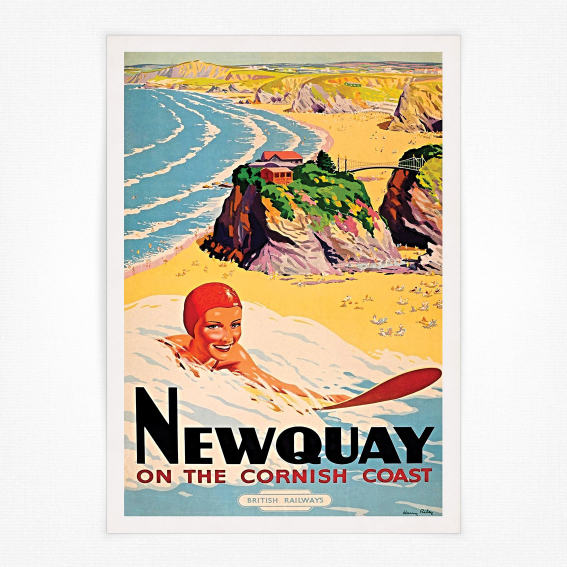
Newquay railway poster on the Cornish Coast – British Railways poster – Harry Riley – C1950
Nestled on the picturesque north coast of Cornwall, Newquay stands as a captivating gem along the Cornish coastline. In a charming portrayal captured by the skilled artist Harry Riley, this seaside town comes alive with vivid imagery. Riley’s Newquay railway poster unveils a scene that beckons with warmth and adventure.
Dominating the picturesque coastal scene, a radiant lady surfer commands our attention. The woman’s captivating smile exudes sheer joy, a testament to the exhilaration that the ocean brings to those who dare to ride its waves. Her crimson swimming cap beautifully complements her matching, hopefully waterproof, bright red lipstick.
With an effortless grace that comes from both skill and a deep connection with the sea, this young woman is in perfect harmony with her surroundings. As she rides over a magnificent wave, her body moves with fluidity, a dance with the very essence of nature. It’s a moment of sheer exhilaration and liberation, where time stands still, and the world fades away, leaving only the serenity of the ocean and the thrill of the surf.
In the backdrop, a vibrant scene unfolds: a multitude of beachgoers indulging in sun-soaked leisure, while the pristine sands of Towan Beach play host to a captivating array of surfers and swimmers. The atmosphere is one of pure delight, as children and adults alike revel in the playful allure of sun, sea, sand, and rock pools.
Towan Beach, unlike its neighbouring beaches Fistral and Watergate Bay, enjoys a unique advantage. Shielded by the imposing cliffs of Towan Head, this idyllic bay is often graced by gentle waves and tranquil waters. This natural sanctuary becomes a haven for novice surfers and families seeking safe waters and sun-soaked shores. In this inviting haven, the essence of Newquay’s coastal charm is beautifully encapsulated by Harry Riley’s artistry.
At the heart of Riley’s composition is a prominent rock formation rising from the sandy shores, known by a plethora of names over the years—Newquay Island, Towan Island, and the House in the Sea. Officially, it bears the name “Jago’s Island,” yet it is most commonly referred to as simply “the Island” today. Jago’s Island also commands attention with its imposing presence, soaring majestically 70 feet above the eastern edge of the beach.
Jago’s Island has been a magnetic attraction for tourists since the early 20th century. Its story is entwined with a bridge built by its owners, who also dared to construct a dwelling upon it during the Edwardian era. This unique abode became a home dwelling for illustrious figures, including Alexander Lodge, the pioneering inventor of the spark plug. Lodge’s abode was a gathering place for distinguished guests, among them Sir Arthur Conan Doyle, the brilliant mind behind the iconic detective Sherlock Holmes. More recently, the Island’s custodians included Viscount Long, a prominent figure as a Whip and Lord in Waiting to the Queen.
Gazing beyond Jago’s Island, one is treated to a breathtaking vista of the Celtic Sea and the dramatic coastline, curving gracefully into the distance. Rugged headlands serve as natural dividers, revealing a succession of coves along the Cornish shore. The Great Western Beach, Tolcarne Beach, and Lusty Glaze Beach all unveil their charms before the eye is drawn to the craggy cliffs of Glendorgal Headland. These individual strands of coastline seamlessly merge into a vast, uninterrupted two-mile expanse of golden sands during low tide—a sight that leaves a lasting impression.
This vintage poster of Newquay, a masterpiece crafted by the English painter, cartoonist, and commercial artist Harry Riley, harks back to the late 1940s. It was published by The Railway Executive (Western Region) and skillfully printed by Beck & Inchbold in Leeds for British Railways. In Riley’s evocative rendering, the allure of Newquay beckons, inviting travelers to embark on a journey to this coastal haven, where the joys of surf, sand, and serenity await.
Jago’s Island: Newquay’s Seaside Marvel
Anyone who has had the privilege of visiting Towan Beach in Cornwall will undoubtedly recall the remarkable view of Jago’s Island, the islet with a house on the top. Fewer people know of its history.
According to Lady Long, who once lived in the island property, the Cornish island once belonged to a Richard Lomax who, in 1838, rented it on a 99-year lease to the Billings Brothers. Using the stack as a garden, the brothers cultivated it into a potato patch. It is rumoured they also kept chickens on the island, leading locals to name the islet Chicken Island
The brothers used the island to planted their gardens atop the stack and cultivated it as a potato patch. Local folklore tells that the Billings Brothers would climb a steep, winding path to get to the summit of the island and would ferry their tools up and transport their harvested potatoes down using donkeys. By all accounts they kept also chickens there too, leading to yet another known name for the islet – Chicken Island.
In 1898, Jago’s Island was put up for sale through an auction. This event might have played a role in the decision to build a bridge connecting the island to the mainland two years later, possibly to make it easier to sell the island as a potential location for building.
In 1905, a summer house was built on the island by Mr. Ambrose Andrews. Around 1910 This was replaced by the current building around 1910, by a Mr. O’Flaherty.
Around 1918, a new owner, Noel Lodge, took possession of the island. He was the son of Oliver Lodge, a well-known local eccentric and the inventor of the spark plug. Noel Lodge was deeply interested in psychic research and is said to have held seances on the island with none other than Arthur Conan Doyle, the famous author of Sherlock Holmes.
The island changed hands once again in 1948, with the keys being handed to John Edgar Cox who used it as an extension of his Minadon Hotel, which was located just across from the island.
Then, in 1960, the island was acquired by Mr Peter Bridgeman Cocks. Given the history of the island, the local councillor who also served as the chairman of Cornwall County Council from 1995 to ’97 was aptly named to own the property.
In 1994, the house was once again put up for sale. It went on the market for £225,000, with a rather intriguing description, emphasising that it was a place “where you wouldn’t have trouble with your neighbours”. It was bought by Alison Richards and Patrick Dormeil, who transformed it into a delightful tea room.
Lord and Lady Long retired to the property in 2001 paying £500,ooo for the house and island. They gave it up in 2012 selling it for an impressive £1 million.
Today, the house has been converted into a luxurious holiday rental, allowing guests to experience its unique charm for a modest fee for a week’s stay. As of 2023 prices ranged from around £1,200 for a four-night stay for two people up to £5,600 for six people for a week in high season.