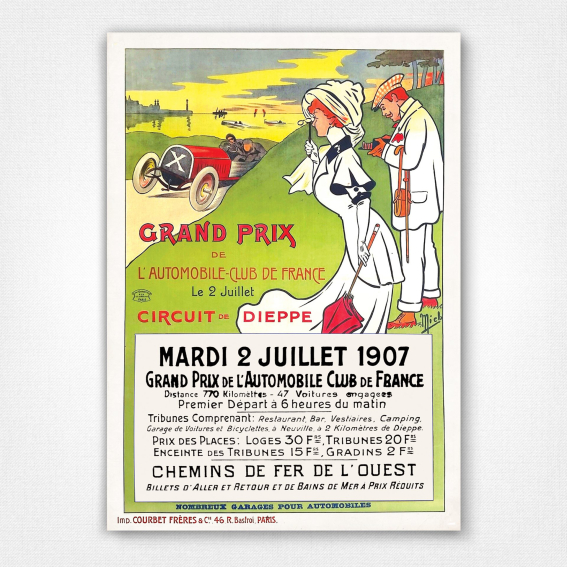
1907 French Grand Prix poster – Circuit de Dieppe – Mich
The 1907 French Grand Prix poster: An invitation to the second ever French Grand Prix
This is a superb reproduction of one of the earliest surviving French Grand Prix posters, a captivating piece of automotive history. Created by the artist Mich for the 1907 French Grand Prix. Mich, whose real name was Michel Liebeaux (1881-1923), was a prominent French poster artist active in the early 20th century.
Mich’s 1907 French Grand Prix poster offers a fascinating glimpse into the thrilling world of early motor racing. This was only the second French Grand Prix ever held, a momentous occasion organised by the prestigious Automobile Club of France. The race itself took place at the Circuit de Dieppe, setting the stage for a day of high-speed drama and exhilarating competition.
The 1907 French Grand Prix poster is a testament to the artistic talent of Mich, a prominent French artist of the era. His style, reminiscent of masters like Toulouse-Lautrec and early Leonetto Cappiello, blended caricature portraits with a vibrant, cartoonish illustrative style. Mich often infused his work with a touch of humor, making his posters both visually striking and engaging.
Mich’s fabulous 1907 French Grand Prix poster depicts a stylish couple enjoying the spectacle. An elegantly dressed woman, adorned with a large hat and carrying a parasol, watches the race through opera glasses. Her dapper companion, meanwhile, has found the perfect vantage point to capture the action with his folding pocket camera as the racing cars speed around the bend.
The poster was designed with versatility in mind. It was printed with an empty space at the bottom, allowing for overprinting with specific details for various events held at the Dieppe Circuit. This particular poster specifically advertises the 1907 Grand Prix organised by the ACF.
The French text on the poster provides key details about the event. It states the date as Tuesday, July 2, 1907, and identifies the event as the Grand Prix of the Automobile Club of France. The race distance was a challenging 770 kilometers, with a remarkable 47 cars entered. The poster also informs attendees about practical matters. The first train to the circuit departs at 6:00 AM, ensuring spectators arrive in time for the start. A range of amenities are available at Neuville, located just 2 kilometers from Dieppe, including a restaurant, bar, changing rooms, camping facilities, and a garage for both cars and bicycles.
Ticket prices are clearly outlined. Boxes offer the most exclusive viewing experience at 30 Francs, followed by grandstand seats at 20 Francs. The Grand Enclosure provides a more general viewing area at 15 Francs, while access to the beaches is available for a more budget-friendly 2 Francs. Convenient transportation is emphasised. The Chemins de Fer de L’Ouest railway company provides transportation to the event, offering discounted single, return, and even sea bathing tickets for attendees.
1907 French Grand Prix at the Circuit de Dieppe
After careful consideration of various options, the ACF settled on a circuit near Dieppe, christened the Circuit de la Seine-Inférieure. This moniker reflected its location within the French department of Seine-Inférieure. However, it’s more commonly known today as the Dieppe Circuit. The course itself was a roughly triangular, almost entirely flat loop spanning 76.988 kilometers. Racers were to navigate this circuit in an anti-clockwise direction, completing a grueling 10 laps for a total distance of 769.88 kilometers. The starting point was situated on the outskirts of Dieppe.
A formidable field of entries
A formidable field of 17 teams, boasting a total of 38 cars, lined up on the grid. French marques were well-represented, with entries from Brasier, Clément-Bayard, Corre, Darracq, Lorraine-Dietrich, Motobloc, Panhard-Levassor, Porthos, and Renault.
International competition was fierce, with entries from Aquila Italiana and FIAT representing Italy, Christie from the United States, Germaine from Belgium, Weigel from England, Mercedes from Germany, and Marchand from Switzerland. While many drivers were veterans of the 1906 Grand Prix, a fresh wave of newcomers added an exciting element to the proceedings.
The 1907 French Grand Prix Race
Thirty-eight cars, starting at one-minute intervals, embarked on ten laps of the challenging 48-mile (77 km) triangular circuit near Dieppe. Vincenzo Lancia’s Fiat led the pack at the start. The race was contested under a fuel consumption limit of 30 liters per 100 kilometers. Louis Wagner held the lead for the first three laps before retiring. Arthur Duray then took over, setting the fastest lap with an impressive average speed of 75.40 mph (121.34 km/h). However, Duray also had to retire on lap nine.
From that point, Felice Nazzaro’s Fiat surged ahead, maintaining its lead until the checkered flag. Nazzaro crossed the finish line with an average speed of 70.6 mph (113.6 km/h), securing victory over Ferenc Szisz in a Renault AK by a margin of over six and a half minutes. Paul Baras, driving a French Brasier, rounded out the podium.
Original posters from this era are highly sought after by collectors and are becoming increasingly rare. This makes them a significant investment for many. However, you can now enjoy the aesthetic appeal of these historical artifacts without breaking the bank. We offer high-quality reproductions that faithfully capture the essence of the original artwork. These superb reproductions allow you to experience the beauty and historical significance of the 1907 French Grand Prix poster while preserving your budget.